Small Business Tax Deductions: What Business Owners Should Review
Small business tax deductions can save you real money.
But only if you know what counts, and can prove it.
Most owners get stuck on the same three questions.
What can I actually write off?
Where's the line between business and personal?
Will the IRS push back?
I hear these from US business owners all the time.
And they're fair.
Small business tax deductions are where the answers matter most.
In this guide, I'll walk you through the small business tax deductions worth reviewing.
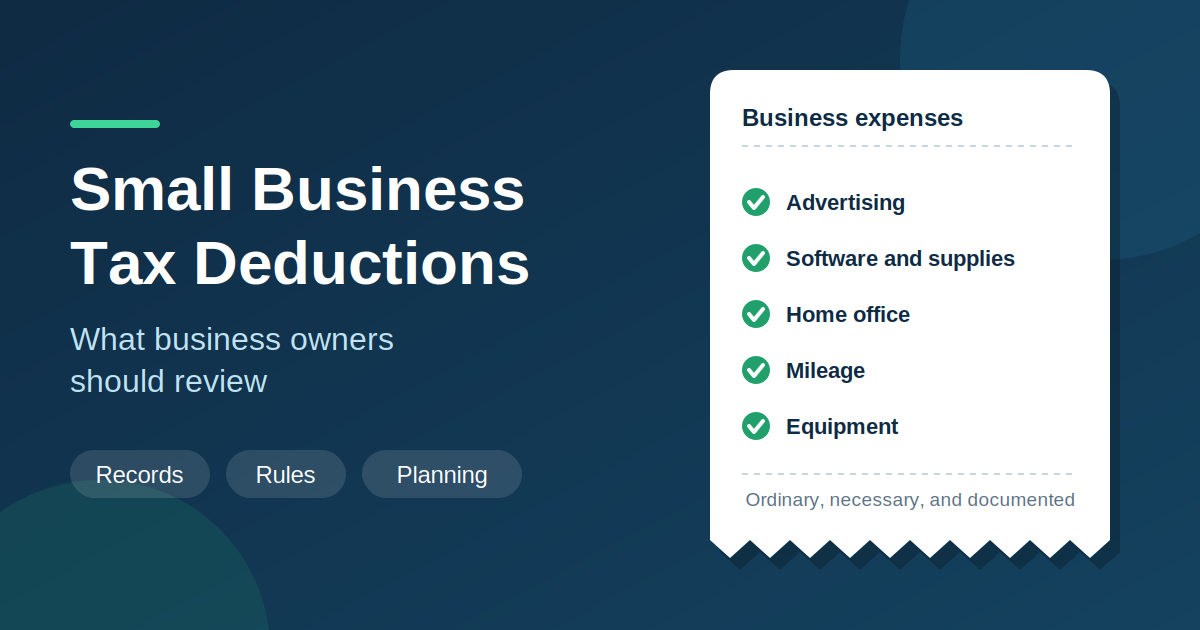
• What counts as a deduction, and the test the IRS uses
• Where personal and business costs split
• Common categories, with the caveats that matter
• What you can't claim
• How to keep records that hold up
• How deductions fit into year-round tax planning
This is general information, not advice.
Review your own facts with a CPA, EA, or tax attorney.
Already have a list and want to plan around it?
You can explore tax planning support from HeyDrew first.
Disclosure: This link is an affiliate link. If you sign up, we may earn a commission at no extra cost to you.
What Are Small Business Tax Deductions?
Small business tax deductions are business expenses you subtract from your income.
That lowers the income you pay tax on.
Less taxable income means a smaller tax bill.
Deduction vs. credit
• Deduction: Subtracts from your income. You pay tax on less.
• Credit: Subtracts from the tax you owe. It cuts the bill itself.
That's how the IRS describes them.
So a $1,000 deduction doesn't cut your tax bill by $1,000.
It lowers your taxable income by $1,000.
What you save depends on your tax rate.
Both can matter.
This guide focuses on small business tax deductions.
Credits work differently, and they have their own rules.
For a closer look, see this guide to small business tax credits.
The "ordinary and necessary" test
The IRS uses one test for most business deductions.
The expense has to be ordinary and necessary.
• Ordinary: common and accepted in your line of business
• Necessary: helpful and appropriate for your business
It doesn't have to be essential.
It does have to be for the business.
That test sits behind every one of the small business tax deductions below.
Deductible vs. Personal Expenses in Small Business Tax Deductions
This is where many owners trip up on small business tax deductions.
The IRS doesn't let you deduct personal costs.
Even if your business benefits a little.
Clearly business
These are the easy ones.
Most owners can claim small business tax deductions like these, if the facts support them:
• Ads and marketing for your business
• Software and supplies you use for work
• Fees you pay to contractors
• Insurance for the business
Mixed use: split it
Some costs serve both sides of your life.
Your phone, your car, and part of your home are common examples.
When an expense is partly business and partly personal, the IRS says to separate the two.
You deduct only the business part.
• Phone and internet: the business share
• Vehicle: business miles only
• Home: only the space you use for business, and only if it qualifies
Keep a note of how you worked out your split.
A simple log works.
Clearly personal
These generally stay off your list:
• Personal, living, and family expenses
• Your commute to your regular workplace
When in doubt, ask a pro before you claim it.
Sorting small business tax deductions into these three buckets saves you headaches later.
Common Small Business Tax Deductions to Review

Start with the everyday costs.
Most small business tax deductions come from here.
Each one comes with a caveat, so check the rules for your situation.
• Advertising: your website, ads, and business cards. Lobbying and political costs are different.
• Bank and payment fees: business accounts only, not personal ones
• Insurance: liability, property, workers' compensation, and similar. Some policies aren't deductible.
• Rent: space or equipment you rent for the business. Not if you're building equity in the property.
• Software and supplies: the ones you use in the business
• Professional fees: accountants, lawyers, and similar, when they relate to running the business
• Contract labor and wages: reasonable pay for work that was actually done
• Taxes and licenses: many business taxes and license fees
Those are the small business tax deductions most owners start with.
Paying contractors?
You may have to file Form 1099-NEC.
The IRS says reporting thresholds rise to $2,000 for payments made after 2025.
Check the current form instructions.
Legal fees to buy a business asset usually get added to its cost instead.
That means a different treatment.
One more rule for sole proprietors.
You can't deduct your own salary or personal withdrawals.
You're not an employee of your business.
Got your list? Now plan around it.
Finding small business tax deductions is step one.
Using them well takes a plan.
HeyDrew is an AI-assisted tax-planning platform for small and mid-sized businesses.
They say tax professionals review the work.
Review tax-planning service options
Vehicle, Home Office and Travel Small Business Tax Deductions
These three get the most questions, and the most attention from the IRS.
Each has rules you need to meet.
Vehicle
You can use one of two methods for business driving:
• Standard mileage rate: 72.5 cents per business mile for 2026, according to the IRS
• Actual expenses: gas, repairs, insurance, and similar costs, split by business use
The IRS says to choose the standard rate in the first year the car is available for your business.
In later years, you can pick either method.
If you use the standard rate, you generally can't also deduct actual costs.
Parking fees and tolls are an exception.
Driving from home to your regular workplace is commuting.
You can't deduct it.
Vehicle small business tax deductions fall apart without a mileage log.
Home office
Your home office has to pass two tests:
• Regular and exclusive use: a space used only for business, on a continuing basis
• A qualifying use: your principal place of business, or a place where you meet clients
You can use the simplified method.
The IRS multiplies $5 by the square feet you use, up to 300 square feet.
Or you can figure your actual expenses on Form 8829.
Home office small business tax deductions get a lot of questions, so keep clear records.
A kitchen table that doubles as a desk usually fails the exclusive-use test.
Travel and meals
Travel has to take you away from your tax home.
It also has to be long enough that you need sleep or rest.
Business meals are generally 50% deductible.
Entertainment is usually not deductible at all.
Keep the receipt, the date, who you met with, and why.
These small business tax deductions are worth claiming only if you can document them.
Equipment and Depreciation Small Business Tax Deductions
Equipment is where small business tax deductions can get big.
Big purchases work differently.
Usually, you spread the cost over several years.
That's called depreciation.
A few rules let you deduct more up front.
Section 179 and bonus depreciation are the equipment small business tax deductions most owners hear about.
• De minimis safe harbor: deduct items up to $2,500 per item or invoice, or $5,000 with an applicable financial statement. You have to elect it.
• Section 179: for 2026, up to $2,560,000, with the phase-out starting at $4,090,000, based on IRS Revenue Procedure 2025-32. The deduction is limited to your business taxable income, and the rest carries forward.
• Bonus depreciation: 100% for qualified property acquired after January 19, 2025, per the IRS
Property generally has to be placed in service during the tax year to count.
Passenger vehicles have extra limits, so ask a pro before you buy one.
Buying more than you need just to get a deduction rarely makes sense.
These equipment small business tax deductions are really a timing question.
Thinking about a big purchase before year-end?
Timing it well is a planning question.
HeyDrew says it works on tax strategies throughout the year, with tax professionals reviewing the work.
Take the HeyDrew assessment to see how their planning works.
Small Business Tax Deductions Owners Often Overlook
Some deductions hide off the main list.
Ask a CPA or EA whether any of these apply to you:
• Qualified business income (QBI) deduction: the IRS says the 20% deduction is now permanent. Eligibility and limits depend on your income and business.
• Self-employed health insurance: you may be able to deduct premiums for yourself and your family.
• Retirement plan contributions: SEP, SIMPLE, and qualified plans can lower your taxable income. A new plan may also earn a startup-cost credit.
• One-half of your self-employment tax: the IRS lets you deduct half of it.
• Tax preparation fees: the part that relates to your business.
• Startup costs: these have special rules, so ask before you assume.
Each of these depends on your facts.
None applies to everyone.
Overlooked small business tax deductions like these are worth a quick check each year.
Not sure which of these apply to you?
A planning conversation is the best place to find out.
HeyDrew's assessment is one place to start, and it can sit alongside your CPA.
Small Business Tax Deductions by Business Type
Your business type changes where deductions show up.
It can also change which ones you can claim.
Sole proprietors and single-member LLCs
Small business tax deductions for sole proprietors usually land on Schedule C.
The profit flows to your personal return.
You pay self-employment tax on your net earnings, and you can deduct half of it.
For more on LLCs, see this guide to LLC tax deductions.
Partnerships and multi-member LLCs
The business files its own return, Form 1065.
Each partner gets a Schedule K-1.
Some small business tax deductions pass through to the partners.
Ask how your partnership handles them.
S corps and C corps
Corporations file their own returns.
S corp owners who work in the business generally run payroll and pay themselves a salary.
That changes how some small business tax deductions work, like retirement plans and health insurance.
Entity rules are complex, so this is a good place to involve a CPA.
Contractors and 1099 workers
Independent contractors usually report on Schedule C.
Contractors may be able to claim small business tax deductions for their own work costs, like tools, software, and mileage.
For more, see this guide to contractor tax deductions.
Whatever your structure, the same "ordinary and necessary" test applies to your small business tax deductions.
What You Can't Claim as Small Business Tax Deductions
Not every expense counts as one of your small business tax deductions.
Here's what the IRS generally says you can't deduct as business expenses:
• Personal, living, and family expenses
• Commuting between home and your regular workplace
• Most entertainment expenses
• Penalties and fines paid to a government for breaking the law
• Bribes and kickbacks
• Lobbying and political contributions
• Improvements to property. These usually get capitalized and depreciated.
• Your own salary as a sole proprietor. You're not an employee of your business.
• Charitable contributions as a business expense. Some owners claim them on a personal return, if they itemize.
Hobby activities have limits too.
If you don't run the activity to make a profit, you generally can't use its losses against other income.
Even a common item can fail your facts.
Check before you claim.
These limits apply to all small business tax deductions.
Record-Keeping for Small Business Tax Deductions
A deduction you can't prove is a deduction at risk.
The IRS can ask for your records.
• Receipts and invoices for every expense
• A mileage log with the date, miles, and purpose
• Separate business accounts and cards
• Monthly bookkeeping, so nothing piles up
• A short note on the business purpose for meals, travel, and gifts
How long to keep records
The IRS gives these general periods:
• 3 years from when you file, in most cases
• 4 years for employment tax records
• 6 years if you left out more than 25% of the gross income on your return
• 7 years if you claimed a bad debt or worthless securities loss
Keep records for property and equipment until you dispose of the asset, plus the period that applies.
Your state may have its own rules.
Good records make every one of your small business tax deductions easier to defend.
Records tell you what happened. A plan tells you what to do next.
If you want planning support on top of your records, HeyDrew is one option.
They say tax professionals review the work.
See how HeyDrew approaches tax planning
How Small Business Tax Deductions Fit Into Year-Round Tax Planning
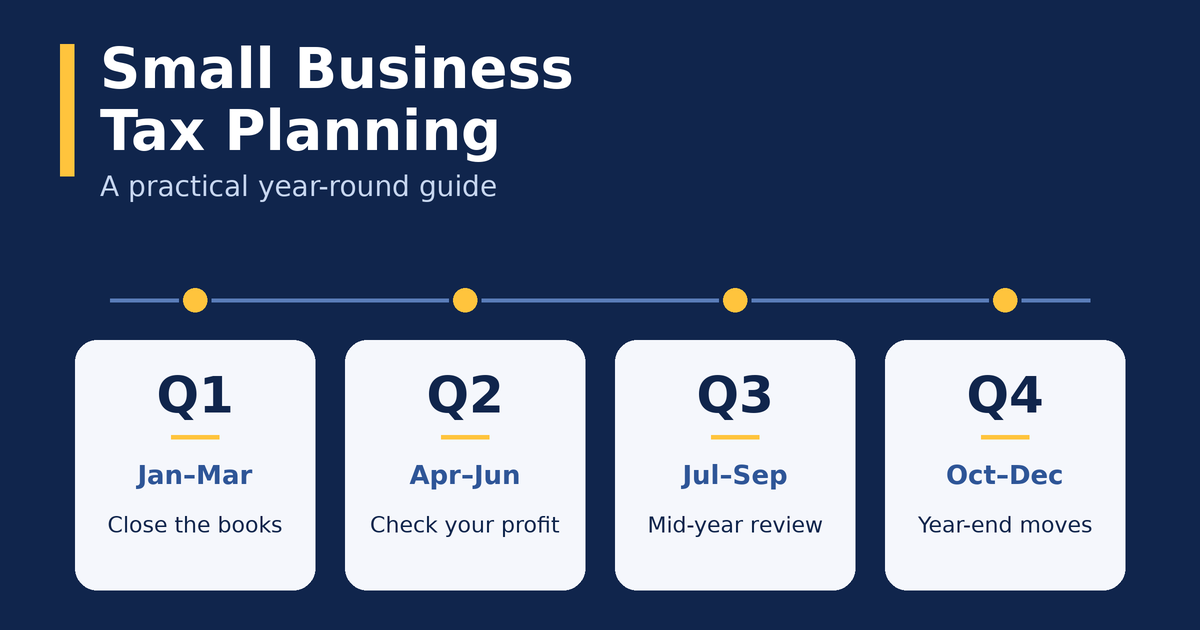
A list of small business tax deductions isn't a plan.
It tells you what you could claim.
It doesn't tell you when to buy, what to pay, or how your structure fits.
That's the gap between claiming deductions and planning around them.
Year-round planning covers more than small business tax deductions:
• Timing: when to buy, bill, and contribute
• Entity choice: whether your structure still fits
• Estimated payments: the IRS says to pay if you expect to owe $1,000 or more
• Records: so every claim holds up
For more on this, see this guide to small business tax planning.
This is the problem HeyDrew is built to help with.
HeyDrew is an AI-assisted tax-planning platform for small and mid-sized businesses.
They say it puts tax strategies in place throughout the year, with tax professionals reviewing the work.
It can sit alongside your CPA.
It isn't a replacement for one.
Not every business will benefit, and results vary.
See how HeyDrew approaches year-round tax planning
Before the year ends
• Review your year-to-date numbers
• Decide on equipment purchases that make sense on their own
• Ask about retirement contributions and their deadlines
• Gather and organize your records
• Book a conversation with your CPA, EA, or planner
If you're reading this before year-end, there's still time to act on your small business tax deductions.
When to Get Help With Small Business Tax Deductions
You can handle simple cases yourself.
Many owners need help with small business tax deductions once things get complicated.
It may be time to get help with small business tax deductions if:
• You have mixed-use assets, like a car or a home office
• You're making a large equipment purchase
• You work in more than one state
• You have employees, contractors, or multiple owners
• You got an IRS notice
• You're changing your business structure
Look for a CPA, EA, or tax attorney.
Those are the pros who can represent you before the IRS.
Ask what's included, how they charge, and what you'll get in writing.
For a closer look at how planning help works, see these tax strategy services.
Want planning support on top of your CPA?
HeyDrew doesn't list its pricing publicly.
You can take their assessment to see how their planning works and what it might cost for your business.
Want to Organize Your Small Business Tax Deductions?
Not sure where to start with your small business tax deductions?
That's fine.
HeyDrew is an AI-assisted tax-planning platform for small and mid-sized businesses.
They say tax professionals review the work.
Pricing isn't listed publicly, and results vary by business.
Not every business will qualify for every strategy.
It can sit alongside your CPA, not replace them.
You can start with a short assessment.
No pressure.
Review tax-planning service options from HeyDrew
Disclosure: This link is an affiliate link. If you sign up, we may earn a commission at no extra cost to you.
Small Business Tax Deductions FAQs
What are small business tax deductions?
Small business tax deductions are business expenses you subtract from your income.
They lower your taxable income.
Most must be ordinary and necessary.
What's the difference between a tax deduction and a tax credit?
Small business tax deductions subtract from your income.
A credit subtracts from the tax you owe.
Can I deduct my home office?
Maybe.
Home office small business tax deductions need regular and exclusive use, plus a qualifying use like a principal place of business.
The IRS simplified method is $5 per square foot, up to 300 square feet.
What small business tax deductions can't I claim?
Personal expenses, commuting, most entertainment, fines and penalties, bribes, and lobbying.
Your own salary as a sole proprietor is also off the list.
Do I need a CPA to claim small business tax deductions?
Not always.
Simple returns can be done with software.
A CPA or EA helps with mixed-use assets, big purchases, multiple states, and IRS notices.
Is there a simpler way to start organizing deductions for a small business?
Yes.
Start with separate accounts and a monthly records routine.
For planning around your small business tax deductions, you can use a platform like HeyDrew, an AI-assisted service for small and mid-sized businesses.
They say tax professionals review the work.
You can review tax-planning service options to see how it works.
Final Takeaway
Know what counts, and what does not.
Split mixed-use costs.
Keep records that hold up.
And remember that no single deduction fits every business.
Do that, and you'll claim with confidence.
Take your time, keep good records, and review your small business tax deductions with a pro.



Comments
Leave a Comment
Your email address will not be published. Required fields are marked *