Tax Strategist vs. CPA: What Does a Business Owner Need?
Tax strategist vs CPA: which one does your business actually need?
I get why this feels confusing.
You run a business. Your taxes got messy.
Someone tells you to hire a tax strategist.
Someone else says a CPA is all you need.
Now you’re stuck.
Here’s what I hear from owners all the time:
• Do I need both?
• Is my CPA supposed to bring me ideas?
• Is “tax strategist” even a real job?
• Am I about to pay for the wrong help?
Fair questions.
Let me walk you through it in plain English.
By the end, you’ll know who does what, where they overlap and what to ask before you hire anyone.
Tax Strategist vs. CPA: The Short Answer
Here’s the quick version.
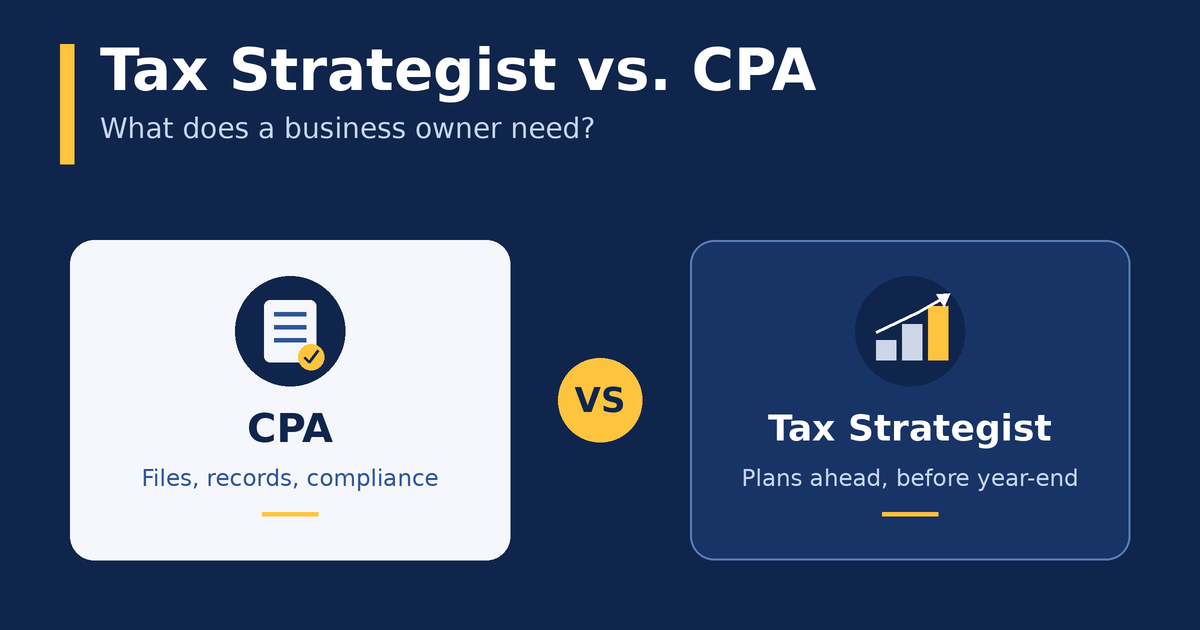
A CPA is a licensed accountant.
They file your returns, keep your records and handle compliance.
A tax strategist plans ahead.
They look at your numbers before the year ends and map out your options.
One catch.
“Tax strategist” is a job description, not a license.
Anyone can use the title.
So I check credentials, not labels.
Which one wins?
Neither.
They do different jobs.
Here’s my simple rule:
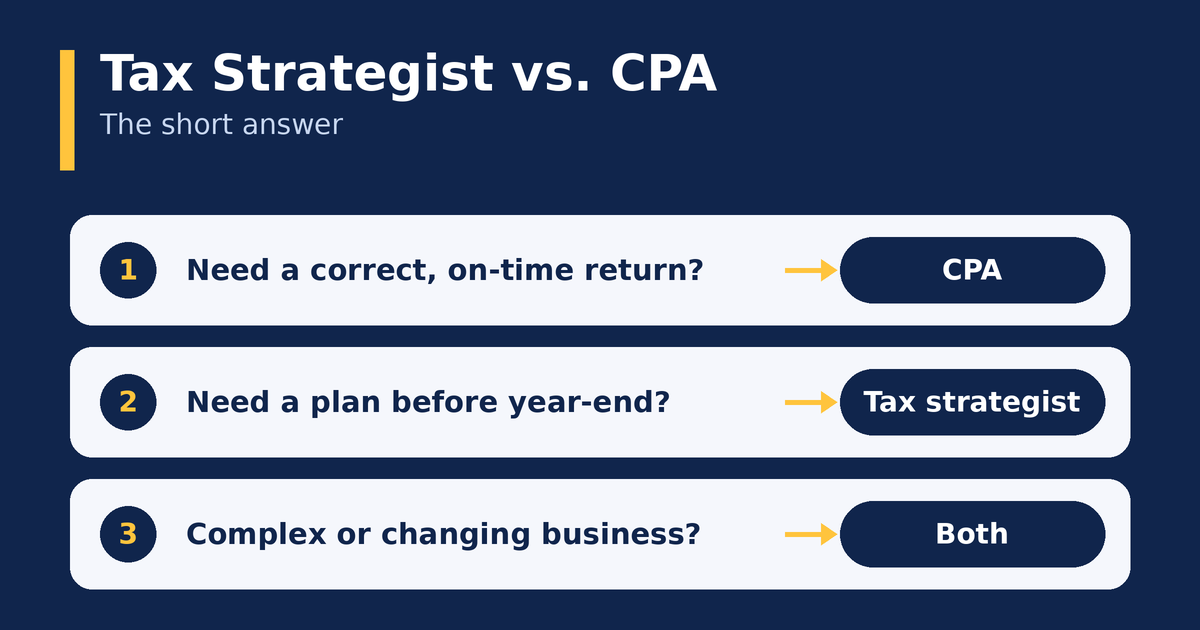
• Need a correct, on-time return? Start with a CPA.
• Need a plan before year-end? Look for a tax strategist.
• Business is complex or changing fast? You may want both.
Some CPAs also plan.
Some strategists are CPAs.
The title tells you less than the work.
What Is a CPA? What Do They Actually Do?
CPA stands for Certified Public Accountant.
It’s a license.
It’s not a title you can print on a business card.
The IRS says CPAs must pass the Uniform CPA Examination.
To keep an active license, they also have to meet ethics and continuing education rules.
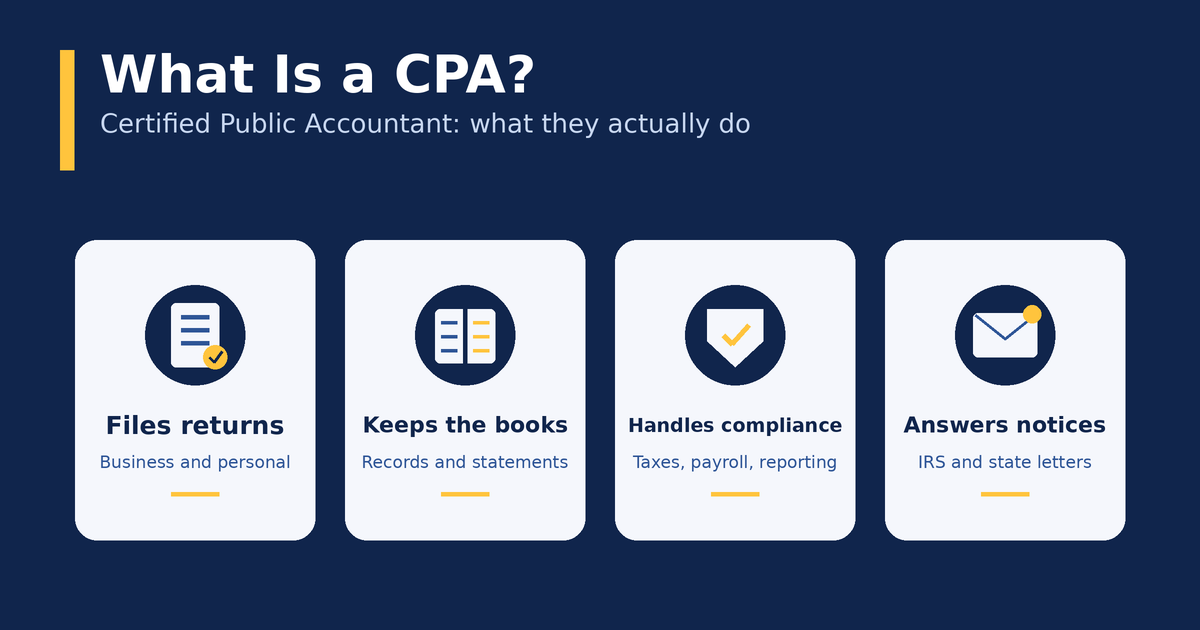
So what does a CPA usually do for a business?
• Files returns. Business and personal.
• Keeps the books straight. Records, statements and reports.
• Handles compliance. Estimated taxes, payroll filings and entity reporting.
• Answers notices. When the IRS or a state writes, they can respond.
• Does audit or review work. Only if the firm offers it.
Here’s something people miss.
The IRS says CPAs have unlimited representation rights.
That means they can speak for you on any IRS matter.
Audits, payment issues, appeals, all of it.
When something goes wrong, that matters a lot.
Now the flip side.
A CPA doesn’t always plan by default.
Some do.
Some focus only on filing and records.
So ask this: is planning part of the deal, or a separate service?
Here’s a made-up example.
Picture a business owner who writes a big check every April.
She figures her CPA is holding back ideas.
But nobody ever scoped planning work.
Her CPA did exactly what she hired him to do.
That’s a scope problem, not a trust problem.
What Is a Tax Strategist? A Title, Not a License
A tax strategist plans what your tax return will say before the year closes.
That’s the job.
But there’s no license called “tax strategist.”
The person using that title might be:
• A CPA who offers planning.
• An enrolled agent (EA), which is a tax pro licensed by the IRS.
• A tax attorney.
• A financial advisor who covers taxes.
• Someone with no tax credential at all.
Two people with the same title can be totally different.
So I look at the credential behind the name.
What does a good strategist do?
• Looks ahead. Reviews your income, entity and goals before year-end.
• Runs projections. Estimates what you may owe under different choices.
• Writes a plan. The moves, the deadlines and the reasons.
• Checks in. Adjusts the plan when your numbers change.
Notice what’s missing?
Filing the return.
Many strategists don’t prepare returns at all.
That’s why the two roles often work side by side.
And here’s what a strategist can’t do:
• Promise savings. Results depend on your facts and the rules that apply to you.
• Rewrite a closed year. Once the year ends, most big choices are locked in.
• Replace the person who signs your return. Whoever signs is who answers for it.
Tax Strategist vs. CPA: Side-by-Side Comparison
Here’s the whole picture in one table.
Treat it as a typical pattern, not a rule.
Plenty of CPAs plan, and some strategists are CPAs.
| CPA | Tax strategist | |
|---|---|---|
| Main job | Prepares and files returns, keeps records, handles compliance | Plans ahead to shape what the return will say |
| Timing | Mostly after the year closes, plus ongoing bookkeeping | Mostly before and during the year |
| Credential | State-licensed CPA | A title, not a license. May be a CPA, EA, attorney, financial advisor or none |
| Typical deliverables | Filed returns, financial statements, notice responses | Projections, a written plan, check-ins |
| Signs your return? | Yes, if the CPA prepared it | Only if the strategist also prepares returns |
| Best for | Accurate, on-time filing and clean records | Decisions that change the outcome, like entity choice and timing |
| Watch for | Planning may sit outside the return fee | Unclear credentials, big claims, plans that don’t match your books |
Read the last row twice.
Each side has a blind spot.
A CPA may not be paid to plan.
A strategist may not see your books.
That gap is where owners lose money.
It’s why many use both.
When a CPA is usually the better fit
• You need your return prepared, filed and defended.
• Your books are messy or behind.
• You have IRS or state notices, amended returns or prior-year cleanup.
• You want planning tied directly to your accounting records.
When a tax strategist is usually the better fit
• You’re making a big call, like choosing an entity or timing a sale.
• Your income changed a lot and you want options before year-end.
• You want projections and a written plan, not just a filed return.
• Your CPA focuses on compliance and you want a dedicated planning talk.
See the overlap?
A CPA who plans fits both lists.
That’s fine.
Match the pro to the job, not the title.
Tax Strategist vs. CPA: Planning, Preparation, Accounting and Compliance
People mix up four words.
Let me clear that up.
• Planning. Choosing your moves ahead of time. This is the strategist’s home turf.
• Preparation. Filling out and filing the return. This is the CPA’s everyday work.
• Accounting. Tracking money in and out so your records are right.
• Compliance. Meeting rules and deadlines, like filings, payroll and estimated taxes.
Want more detail?
Read our guide on tax planning vs. tax preparation.
Now the “tax strategist or accountant” question.
They’re not rivals.
An accountant, including a CPA, keeps score.
A strategist helps you decide how to play.
You need the score to be right.
You also need a game plan.
Online options exist for the game plan too.
One example is AI-assisted tax planning, which some owners use next to their CPA.
Tax Advisor vs. CPA vs. Tax Planner: Do Titles Matter?
Titles in this field overlap a lot.
Here’s how I read them.
Tax advisor vs CPA.
“Tax advisor” is a broad label.
“CPA” is a license.
An advisor may be a CPA, an EA, an attorney or someone with no tax credential.
If you want a business tax advisor, ask which credential they hold.
Tax planner vs CPA.
A tax planner focuses on planning.
A CPA covers more ground, from the books to the return.
Many CPAs plan too.
So the real question isn’t the title.
It’s the scope.
Same goes for a business tax consultant.
The label doesn’t tell you what you’re buying.
The engagement does.
Ask these three things, whatever the title:
1. What credential do you hold?
2. What work will you do for me?
3. Who prepares and signs the return?
Here’s a quick test.
Swap the title for the work.
“I’m hiring someone to plan my taxes” and “I’m hiring someone to file my taxes” are two different jobs.
Say which one you mean, and the title stops mattering.
Online platforms add one more option.
HeyDrew is one AI-assisted choice to look at.
It may complement a CPA.
It doesn’t replace one.
Tax Strategist vs. CPA for Business Owners: What Fits Your Stage?
Your stage should set your setup.
Here’s my “start here” guide.
No prices, because fees vary a lot by provider and scope.
Sole proprietor or freelancer
Start with a CPA or EA for your return and records.
Add a planning check-in if your income jumps.
Small business with employees
Payroll and filings pile up fast.
Get the basics clean with a CPA first.
Add planning once things run smoothly.
S corp or partnership
Entity rules matter here.
For example, S corp owners who work in the business must pay themselves reasonable compensation.
That means a salary that fits the work.
Planning and compliance need to line up.
Multi-state business
Every state adds rules.
Ask whoever plans for you if they model state tax too.
Big sale, big purchase or high income
Plan before the deal closes.
After is too late.
Bring both pros in.
The logic is simple.
Cover compliance first.
Then add planning where it matters most.
If you want proactive planning on top of your CPA, HeyDrew is an AI-assisted tax-planning option that may complement your CPA.
Review tax-planning service options.
Tax Strategist vs. CPA: Why Many Businesses Use Both
Using both isn’t a waste.
It covers two different risks.
• Timing. A CPA often sees you after the year closes.
• Timing, part two. A strategist works while you can still change things.
• Scope. A return fee covers the return, and planning is extra work.
• A second set of eyes. Each pro can catch what the other misses.
But two pros only help if they work together.
Here’s how I’d set that up:
1. Share the same records. Both should see the same books and prior returns.
2. Agree on who signs. Know who prepares the return and who defends it.
3. Set a mid-year check-in. Do it while year-end moves are still open.
4. Match strategy to the books. A plan that doesn’t fit your records is a problem waiting to happen.
5. Run big moves past your CPA first. Before you act, not after.
One warning.
Don’t let anyone tell you a plan replaces your CPA.
A good plan works with your filing, not around it.
A simple example
This is a made-up example. It’s not a result and not a promise.
Picture an S corp owner who wonders how to pay himself.
The strategist models a few options and writes up the tradeoffs.
Then the CPA checks how each option affects payroll, state tax and the return.
He picks one before year-end.
Both pros used the same records.
So nothing surprises him in the spring.
Neither pro did the whole job.
Together, they covered it.
Want planning support that may fit alongside your CPA?
HeyDrew is one option.
Review tax-planning service options.
How to Check Credentials Before You Hire
Don’t trust a title.
Check it.
It takes a few minutes.
Start with what the IRS says.
Generally, anyone paid to prepare a federal return must have a Preparer Tax Identification Number (PTIN).
The IRS also says CPAs, enrolled agents and attorneys have unlimited representation rights.
Then do this:
1. Ask for the credential. CPA, EA, attorney or other.
2. Ask for a license number. If they have one.
3. Verify a CPA with the state board. Each state licenses its own CPAs.
4. Use the IRS directory. It lists attorneys, CPAs, enrolled agents and others with a valid PTIN.
5. Ask about the return. Who prepares it, and who signs it?
A note on strategists.
Many don’t prepare returns, so a PTIN may not apply to them.
That’s fine.
Just ask who does the filing, and check that person too.
Why bother?
Because the credential decides what the person can do for you.
Someone with unlimited representation rights can speak for you on any matter before the IRS.
Someone without them has narrower options if a problem comes up.
Know which one you’re hiring before you need them.
The IRS also publishes guidance called “Choosing a Tax Professional.”
Read it before you sign anything.
Tax Strategist vs. CPA: Questions to Ask and Red Flags
Questions to ask
Ask these before you hire either one.
1. What credentials do you hold, and can I verify them?
2. What’s included in your fee?
3. Who prepares and signs my return?
4. How will you document your advice?
5. Do you model state tax, payroll and my entity rules?
6. How will you work with my other tax pro?
Write the answers down.
Good pros answer plainly and put details in writing.
Vague answers usually mean vague work.
Red flags
Walk away if you see any of these:
• Guaranteed savings. Nobody can promise results without knowing your full situation.
• One-size-fits-all plans. Your business isn’t anyone else’s.
• No look at your records. Advice without your numbers is a guess.
• Advice that ignores your return. A plan has to show up correctly on the filing.
• Pressure to sign fast. Good advice doesn’t expire in 24 hours.
• Vague credentials. If they dodge the question, that’s your answer.
One red flag means pause.
Two means leave.
Next Step: Compare Your Options
Compare first.
Then decide.
If you want AI-assisted planning in the mix, HeyDrew is worth a look.
It may complement your CPA.
Review tax-planning service options.
I couldn’t find published pricing for HeyDrew, so check its site for current rates.
Results vary by situation.
Nothing here is a promise of savings.
Disclosure: this is an affiliate link. If you sign up through it, I may earn a commission at no extra cost to you.
Tax Strategist vs. CPA FAQs
Is every tax strategist a CPA?
No.
“Tax strategist” is a title, not a license.
Some strategists are CPAs, enrolled agents, attorneys or financial advisors.
Others hold no tax credential.
Always verify.
Can a CPA also be a tax strategist?
Yes.
Many CPAs offer planning along with preparation.
Ask whether planning is in your fee or sold separately.
Which is better for a small business?
Neither is better in every case.
Most small businesses need compliance first.
So a CPA or EA is the usual starting point.
Add planning when your income or structure gets more complex.
Do I need both a tax strategist and a CPA?
Often, yes, once your business gets complex.
A CPA keeps your filings and records right.
A strategist helps you plan ahead.
If you want a planning option next to your CPA, HeyDrew is one to consider.
What’s the difference between a tax advisor and a CPA?
“Tax advisor” is a broad label.
“CPA” is a state license.
An advisor may be a CPA, but doesn’t have to be.
Check the credential behind the title.
Is a tax planner the same as a tax strategist?
Usually the terms mean the same kind of work: planning ahead.
Neither is a license.
Ask what credential the person holds and what they’ll actually do for you.
That’s the real answer to tax strategist vs CPA: match the pro to the job, not the title.





Comments
Leave a Comment
Your email address will not be published. Required fields are marked *