How Much Does a Tax Strategist Cost?
Tax strategist cost runs from $100 an hour to $20,000+ a year.
That’s a wide range. Here’s why.
Every number below comes from a firm that sells tax services. They’re pricing their own work. So treat these as asking prices, not market averages.
• Hourly: Monily says $100 to $500. SDO CPA says Big Four firms charge $300 to $800+.
• Flat-fee projects: Monily says $1,000 to $10,000+.
• Retainers: Monily says $2,000 to $20,000+ a year. SDO CPA says mid-size firms charge $1,500 to $3,500 a month. Boutique firms run $3,000 to $12,000 a year. Solo practitioners run $2,000 to $10,000.
• Small-firm minimums: LifeCycle Tax Advisors lists $750 per quarter for proactive planning.
Why don’t the numbers match? Simple. The firms sell different things.
A solo planner and a Big Four firm are not the same product. Scope changes the price. So does complexity. So does how often you meet.
So what’s your tax strategist cost? It depends on who you hire and what they do.
The next sections show you how to figure it out.
Want to see your options first? Review tax-planning service options.
What a Tax Strategist Does (and What You’re Paying For)
A tax preparer reports what already happened. A tax strategist plans what happens next.
That’s the core difference. And it’s where your money goes.
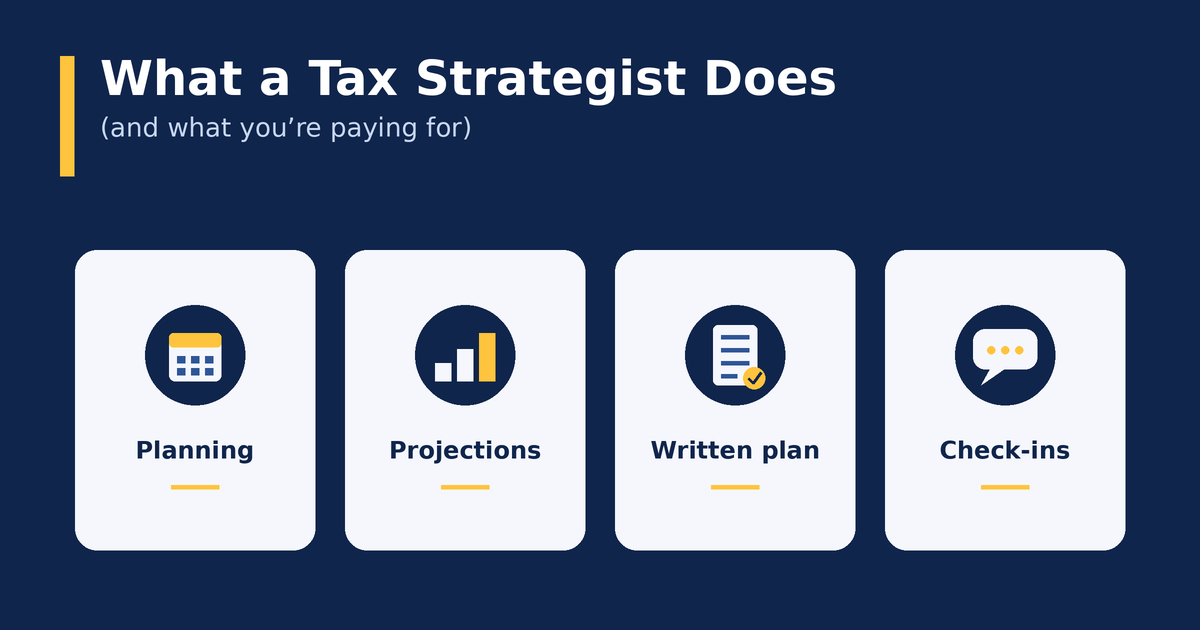
Here’s what you’re usually paying for:
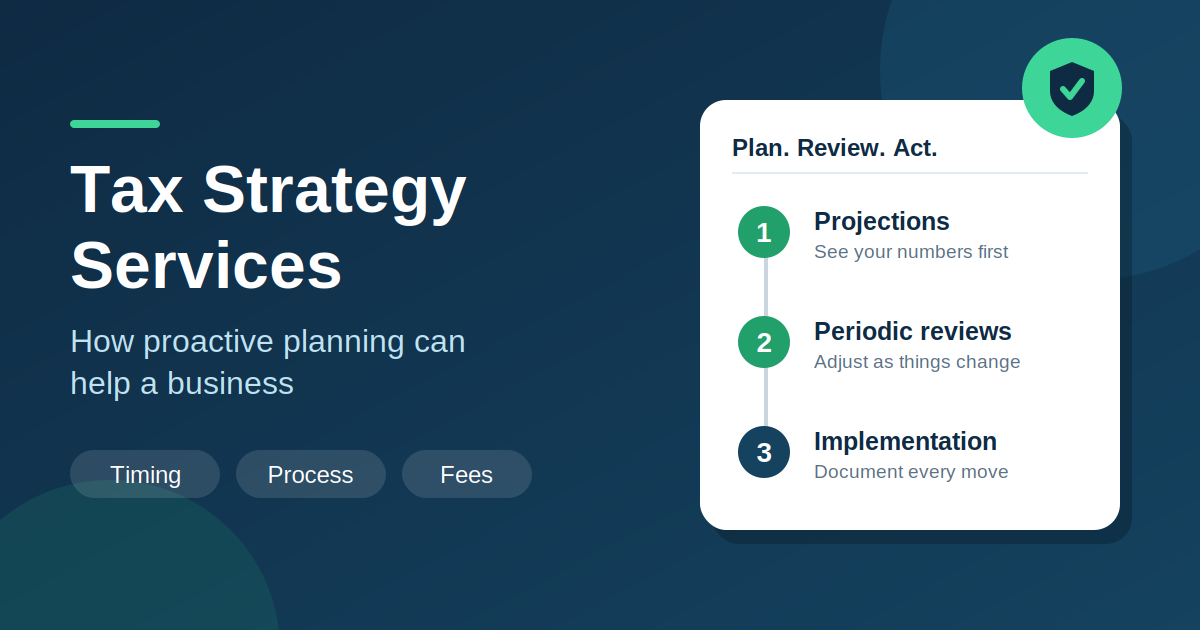
• Planning. Looking at your income, your entity and your goals before the year ends, not after.
• Projections. Estimating what you may owe, so you can plan around it.
• A written plan. The moves you can make, in writing, so you know what to do and when.
• Check-ins. Regular meetings to adjust as your numbers change. LifeCycle Tax Advisors, for example, builds in quarterly meetings and estimated tax payment analysis.
The strategies themselves vary. The firms we reviewed mention things like entity structuring, retirement contributions, charitable deductions and R&D credits. Which ones fit you depends on your situation.
Now the part that matters for price. You’re not buying a return. You’re buying time, judgment and a plan. That’s why tax strategy cost doesn’t look like a simple filing fee.
More hours and more complexity mean a higher fee. Fewer meetings and a simpler setup mean a lower one.
Next, we’ll break down the actual pricing models.
Tax Strategist Cost by Fee Structure: Hourly, Flat Fee and Retainer
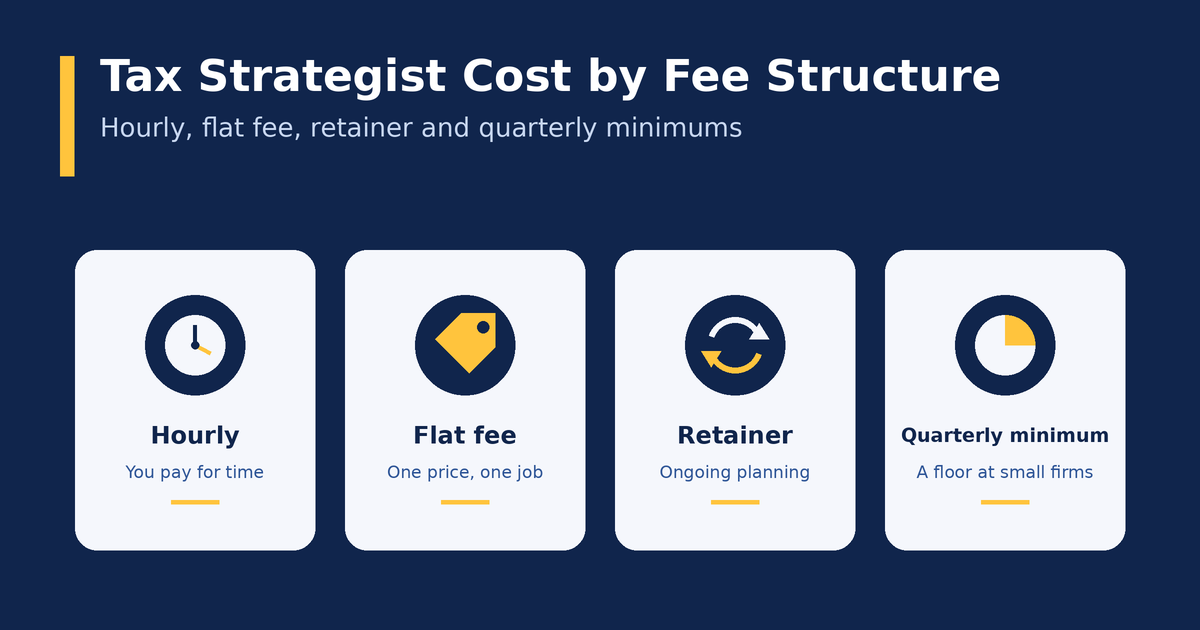
Tax strategist pricing comes in four shapes. Each one suits a different need.
A quick reminder: every figure here is a firm’s own published claim. Use them as reference points, not promises.
Hourly rates
You pay for time. Monily says $100 to $500 an hour. SDO CPA says Big Four firms charge $300 to $800+.
Hourly works for one-off questions. It gets expensive when the scope isn’t clear.
Flat-fee projects
You pay one price for one job. Monily says $1,000 to $10,000+.
Think of a specific project, like a planning review or an entity setup. The scope is fixed, so the bill is too.
Annual or monthly retainers
You pay a set amount for ongoing planning. This is where the sources spread out the most:
• Monily: $2,000 to $20,000+ a year.
• SDO CPA, mid-size firms: $1,500 to $3,500 a month.
• SDO CPA, boutique firms: $3,000 to $12,000 a year.
• SDO CPA, solo practitioners: $2,000 to $10,000.
Retainers usually cover regular check-ins and a running plan. Ask what’s in it before you sign.
Quarterly minimums at small firms
Some small firms set a floor. LifeCycle Tax Advisors lists $750 per quarter for proactive planning.
They also list separate minimums for filing: $1,000 to prepare an individual return and $1,500 for a business return. Those are preparation fees, not planning fees. Don’t mix them up.
Why the numbers don’t match
Three reasons:
1. Different providers. A Big Four firm and a solo planner price differently.
2. Different scope. One fee may include returns. Another may not.
3. Different clients. Complexity moves the price.
Other guides on this site cite slightly different hourly ranges, depending on their sources. That’s normal. Compare scope first, then price.
The best tax strategist pricing is the one that matches what you actually need.
What’s Included in Tax Strategist Cost (and What’s Not)
Two firms can quote the same price and deliver very different things. So check what’s inside the fee before you compare numbers.
That’s true for the cost of tax planning services across the board.
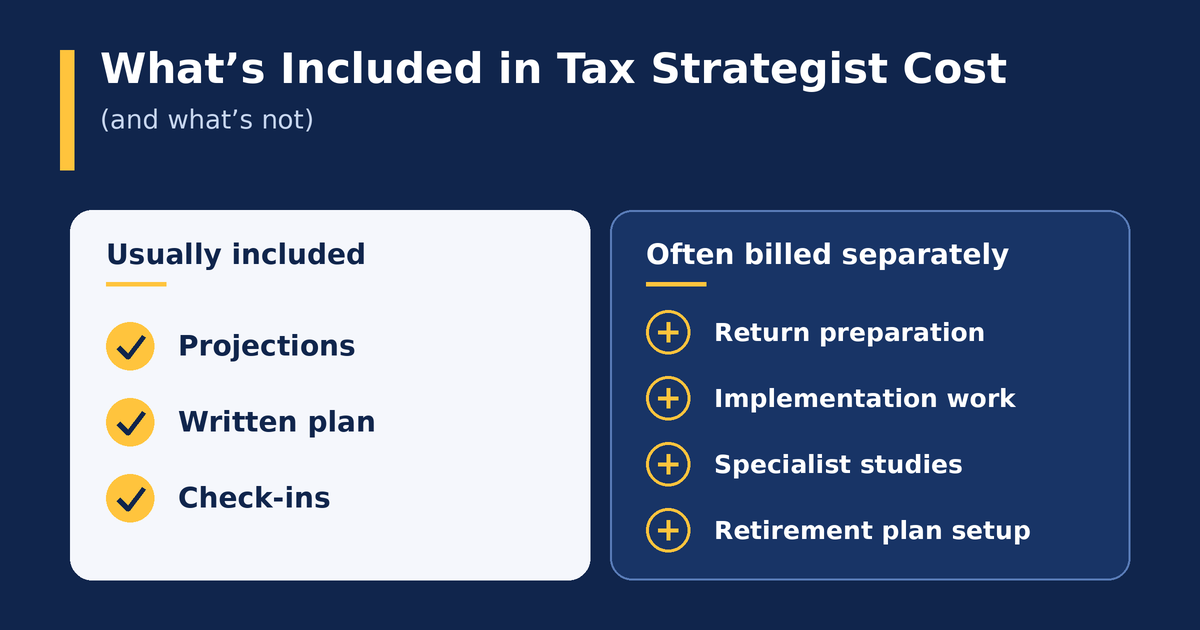
What’s usually included
Most planning fees cover the core work:
• Projections. An estimate of what you may owe.
• A written plan. The moves you can make, and when.
• Check-ins. Regular meetings as your numbers change.
LifeCycle Tax Advisors, for example, describes quarterly meetings and estimated tax payment analysis. It also expects you to keep your financials up to date. That’s your part of the deal.
What’s often billed separately
This is where the bill grows. Ask about each of these:
• Return preparation. SDO CPA says some firms bundle it. Others price it separately. LifeCycle lists its own fees for individual and business returns.
• Implementation work. A plan on paper isn’t a plan in action. Setting it up can cost extra.
• Specialist studies. SDO CPA names cost segregation as an example. It says advanced strategies like this are often priced as one-time projects.
• Retirement plan setup. SDO CPA mentions defined benefit plans and solo 401(k)s in this category.
• Representation. Audit or IRS representation may sit outside the base fee. LifeCycle and Monily both mention it as a service.
Onboarding and minimum fees
Some firms charge to get you started. LifeCycle lists an onboarding fee and a minimum fee. Ask for the exact onboarding amount.
A minimum can also change what you pay. A small planning need may still hit the floor.
The rule is simple. Get the scope in writing. Then compare prices.
What Pushes Tax Strategist Cost Up or Down
Your price isn’t random. A few things drive it.
Some you control. Some you don’t. Know which is which.
The big drivers
• Entity type. A sole proprietor is simpler than an S corp, partnership or C corp. More structure means more work.
• Income streams. One paycheck is easy. Business income, rental income and investments add up fast.
• States. Filing in several states means more rules and more time.
• How clean your books are. LifeCycle Tax Advisors expects up-to-date financials. If your records are a mess, someone has to fix them. That time gets billed.
• How often you meet. SDO CPA says an annual planning session costs less. Quarterly touchpoints cost more. Monthly access costs the most.
• Who does the work. SDO CPA says pricing depends on practitioner experience and client complexity. A senior partner costs more than a solo planner.
Add one more: implementation. If you want the firm to carry out the plan, not just write it, expect a bigger bill.
Lower cost vs. higher cost
Usually lower:
• Simple entity setup
• One state
• Clean, current books
• One planning session a year
• Planning only, with no implementation
Usually higher:
• Several entities
• Multiple states
• Messy or late records
• Quarterly or monthly meetings
• Hands-on implementation and specialist studies
You won’t change everything. But clean books and a clear scope are easy wins. They bring your tax strategist cost down without cutting the value.
Tax Strategist Cost for a Small Business: What Fits Your Stage?
Your business stage should set your budget. Not the other way around.
You don’t need a full retainer on day one. Match the service to where you are. Here’s a simple “start here” guide.
• Freelancer or sole proprietor. Start small. A one-time planning session or a flat-fee project is usually enough. Skip the retainer until your income gets complicated.
• Small business with employees. Payroll adds work. Start with an annual plan and a mid-year check-in. Add meetings as you grow.
• Growing S corp. This is where quarterly meetings start to pay off. Ask about reasonable compensation, which is the salary you pay yourself as an owner. Also ask how estimated taxes get handled.
• Multi-state. Every state adds rules. Ask whether state work is included or billed on top. This one moves tax planning fees more than most.
• Owner with significant wealth. Your needs go beyond one entity. Expect an ongoing relationship, a wider scope and a higher fee.
Here’s the logic. Buy the smallest service that covers your real risk. Then scale it up.
Not sure where you fit? A small business tax advisor can tell you which stage you’re in. Ask for a written scope and a written quote first.
Running a small or mid-sized business and want to compare your options? Review tax-planning service options.
Your tax strategy cost should grow with your business. It shouldn’t run ahead of it.
Tax Strategist Cost vs. CPA Fees vs. Online Platforms
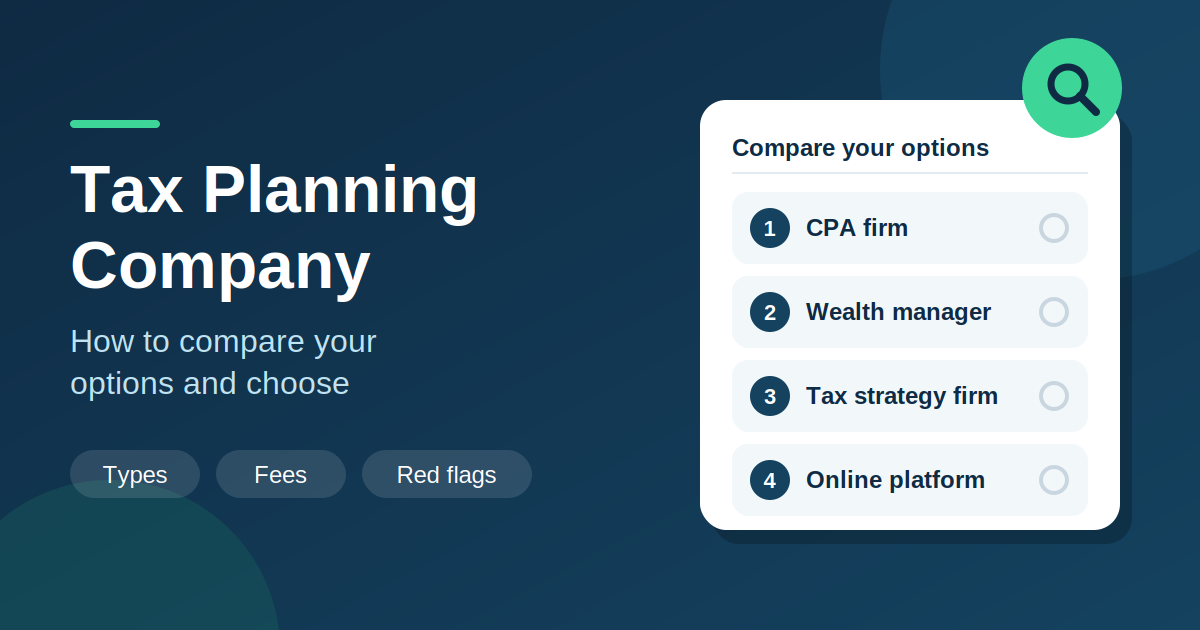
Three types of providers. Three ways to pay. Here’s how each one usually charges.
Tax strategist or advisory firm. You pay for planning. That means hourly rates, flat-fee projects or a retainer. See the fee structures above. This suits you if you want a plan and ongoing check-ins.
CPA or tax preparer. You pay for filing. Pricing is often per return. LifeCycle Tax Advisors lists $1,000 for an individual return and $1,500 for a business return. Some CPAs also offer planning, usually priced separately. This suits you if your main need is an accurate return.
Online and AI-assisted platforms. You pay for software-driven planning, sometimes with human review. Pricing varies a lot by platform. Some use a subscription. Others charge per service. This suits you if you want a lower-touch start, or want to compare before you commit.
None of these is “best.” Each one fits a different need.
Here’s how to compare them fairly:
1. Check what the fee covers.
2. Check who does the work.
3. Check whether returns are included.
Want to see what else is out there? Browse a tax planning company comparison first.
Then, if you want an AI-assisted option in the mix, HeyDrew is one to look at. We couldn’t find published pricing for it, so check its site for current rates. Review tax-planning service options.
A lower sticker price isn’t always a lower tax strategist cost. Scope decides that.
Is Tax Strategist Cost Worth It? A Simple Way to Test the Value
Maybe. It depends on your numbers. Here’s a quick test.
The break-even check
Ask one question: can the strategist show me savings I can document that beat the fee?
Do this before you sign:
1. Ask for the specific strategies they’d use for your situation.
2. Ask how each one saves money, and what it costs to put in place.
3. Add up the savings you could point to on paper.
4. Compare that total to the fee, plus any implementation costs.
If the savings clearly beat the cost, the math works. If they’re vague, it doesn’t.
Don’t trust unsourced ROI numbers
Some firms publish big return multiples. Some show savings examples. Most don’t say where the numbers come from.
That’s a self-published claim. It’s not proof. Your savings depend on your income, your entity and the rules that apply to you. Nobody can promise a result. If a firm does, walk away.
When it may not be worth it
A strategist may not pay off if:
• Your return is simple. One income source and few deductions leave little to plan.
• Your complexity is low. Fewer moving parts means fewer opportunities.
• You can’t fund the plan. Some strategies cost money up front. No cash means no way to act.
In those cases, a lower-cost option may fit better. Start small, then scale up.
Want to compare before you decide? Review tax-planning service options.
Worth it is a math question. Run the math first.
Questions to Ask About Tax Strategist Cost Before You Sign
Ask these seven questions. Write down the answers. A good strategist won’t dodge any of them.
1. How do you charge: hourly, flat fee or retainer?
You want to hear: a clear fee basis, stated up front.
2. What’s included in that fee?
You want to hear: a specific list, such as projections, a written plan and check-ins.
3. What’s billed separately?
You want to hear: a plain list of extras, like return preparation, implementation work or specialist studies.
4. Is there an onboarding fee or a minimum?
You want to hear: the exact amounts, before you commit.
5. How do you price changes in scope?
You want to hear: a set rate or a written approval step before extra work starts.
6. What happens if I cancel or I’m not happy?
You want to hear: clear refund or cancellation terms, in writing.
7. Can I get a written estimate?
You want to hear: “Yes.” Then get it, with the scope attached.
If any answer is vague, push. If it stays vague, move on.
The goal isn’t the lowest price. It’s no surprises. Clear answers protect your tax strategist cost from creeping up later.
Tax Strategist Cost Red Flags to Walk Away From
Some pricing patterns tell you everything. Spot them early. Walk away fast.
• Fees based on a percentage of your refund. This ties their pay to your refund, not to good planning. It can push the wrong incentives.
• Guaranteed savings. Nobody can promise a result without knowing your full situation. A guarantee is a sales line, not a plan.
• Vague scope. If they can’t say what you’re getting, you can’t judge the price. Ask for it in writing.
• A large upfront payment with no written plan. You should see what you’re buying before you pay big. No plan on paper means no way to hold them to anything.
• Pressure to sign fast. Good advice doesn’t expire in 24 hours. Urgency is a tactic.
• No credentials. Ask what they hold, such as CPA or EA. Then check. The IRS directory of federal tax return preparers is one place to look.
• They won’t sign returns. A paid preparer is required to sign the return they prepare. If one refuses, that’s a problem.
One red flag is a reason to pause. Two is a reason to leave.
A fair tax strategist cost comes with clear terms and honest claims. Anything else, skip.
Want to Compare Tax Strategist Cost Before You Commit?
Compare first. Then decide.
If you want an AI-assisted option in the mix, HeyDrew is worth a look. Review tax-planning service options.
We couldn’t find published pricing for HeyDrew, so check its site for current rates. Results vary by situation, and nothing here is a promise of savings.
Disclosure: this is an affiliate link. If you sign up through it, we may earn a commission at no extra cost to you.
Tax Strategist Cost FAQs
How much does a tax strategist cost?
It depends on the provider and the scope. The firms we reviewed publish hourly rates from $100 to $800+, flat-fee projects from $1,000 to $10,000+, and retainers from $2,000 to $20,000+ a year. Those are each firm’s own figures. Treat them as reference points, not averages.
Why does tax strategist pricing vary so much?
Because the services differ. Provider type, scope, entity complexity and how often you meet all move the price. Implementation work and specialist studies often cost extra.
Are tax planning fees tax deductible?
Sometimes. Fees tied to a business, rental or farm are generally deductible, while fees for personal tax advice and planning are not deductible on a personal return. The miscellaneous itemized deduction that once covered personal tax preparation fees was permanently eliminated starting in 2026. Ask your strategist to split business and personal work on the invoice, and confirm with a tax professional.
Is a tax strategist worth the cost for a small business?
It can be. It’s a math question. Compare savings you can document against the fee and any implementation costs. If your return is simple, it may not pay off.
What does the cost of tax planning services usually include?
Usually projections, a written plan and regular check-ins. Return preparation, implementation work, specialist studies and retirement plan setup are often billed separately. Get the scope in writing.
Is there a simpler way to start with tax planning?
Yes. Start small. Try a one-time planning session, an annual plan or an online or AI-assisted platform. Then scale up if the numbers justify it.




Comments
Leave a Comment
Your email address will not be published. Required fields are marked *