
Easyship vs ShippingEasy: Which Shipping Software Wins in 2026?
If you are weighing up Easyship vs ShippingEasy, you are comparing two platforms that sound similar but work very differently.
Both help ecommerce sellers automate shipping, print labels, and save on carrier rates.
But one is built for domestic US sellers who want to keep things simple and affordable. The other is built for brands that are growing globally and need a platform that handles international complexity without breaking a sweat.
I have tested both. Here is the honest breakdown.
The Quick Answer
Choose Easyship if:
- You ship internationally or plan to expand globally
- You want automatic duty, tax, and customs calculations at checkout
- You need access to 250 plus global couriers without negotiating your own rates
- You want a branded returns portal and a polished post-purchase experience
- You are building a brand that needs room to grow
Choose ShippingEasy if:
- You ship primarily within the US via USPS, UPS, or FedEx
- You want built-in email marketing tools alongside shipping
- You need strong inventory management in one platform
- Your operation is domestic-focused and growing steadily
Let us get into the details.
What Is Easyship?
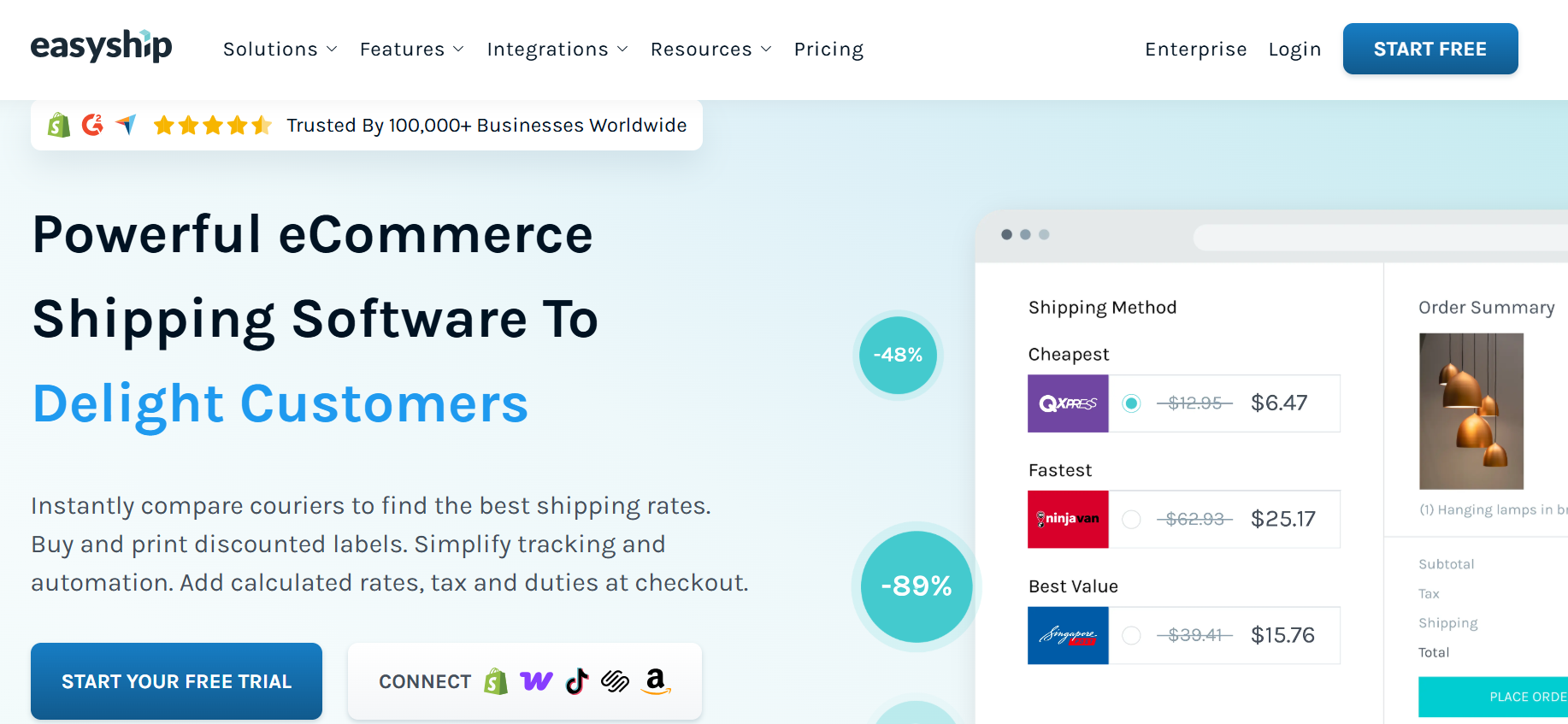
Easyship is a cloud-based ecommerce shipping platform built for brands selling across borders.
It connects you to 250 plus global couriers, calculates duties and taxes automatically at checkout, generates customs documentation, and shows customers their full landed cost before they pay.
It is the go-to international shipping software for stores that want to grow beyond their home market without turning logistics into a full-time job.
Read the full Easyship review here if you want to go deeper on the platform.
What Is ShippingEasy?
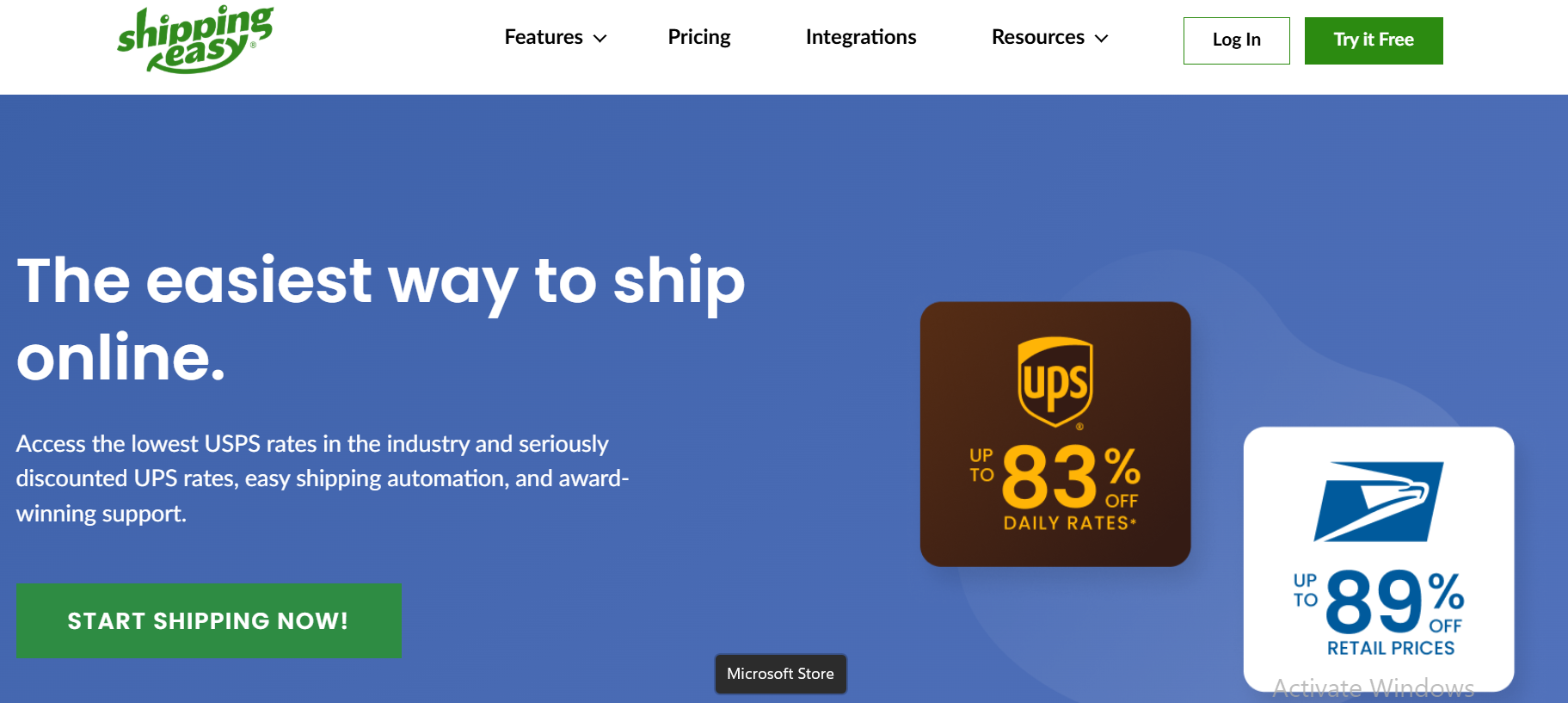
ShippingEasy is a cloud-based shipping platform built for small to mid-size US ecommerce sellers.
It connects to USPS, UPS, FedEx, and DHL, offers discounted rates on USPS and UPS, automates order imports from multiple sales channels, and includes tools for inventory management and email marketing.
The name sells itself. It is genuinely easy to use, especially for sellers managing orders across multiple platforms like Shopify, Amazon, Etsy, and eBay.
Where it starts to show its limits is in international shipping depth and carrier variety.
Easyship vs ShippingEasy: Side-by-Side Comparison
Here is a full shipping software comparison of both platforms:
| Feature | Easyship | ShippingEasy |
| Best For | International ecommerce sellers | US domestic sellers, multi-channel |
| Starting Price | Free plan available | Free starter plan available |
| Paid Plans | From $29 per month | From $19.99 per month |
| Carrier Support | 250 plus global couriers | USPS, UPS, FedEx, DHL only |
| Tax and Duty Estimates | Automated at checkout | Limited, no checkout calculation |
| Customs Documentation | Auto-generated | Basic via GlobalPost program |
| Automation Rules | Yes | Yes, solid for domestic |
| Batch Label Printing | Yes | Yes |
| Returns Portal | Customizable branded portal | Basic, no native automated portal |
| Inventory Management | Basic | Strong |
| Email Marketing Tools | No | Yes, built-in |
| Integrations | 100 plus | 30 plus |
| Customer Support | Email, chat, 24/7 on higher plans | Phone, email, chat on paid plans |
The ShippingEasy vs Easyship comparison makes it clear both tools cover the basics well. Where they split is international shipping software capability and post-purchase experience.
Pricing: How Much Does Each Platform Cost?
Easyship Pricing
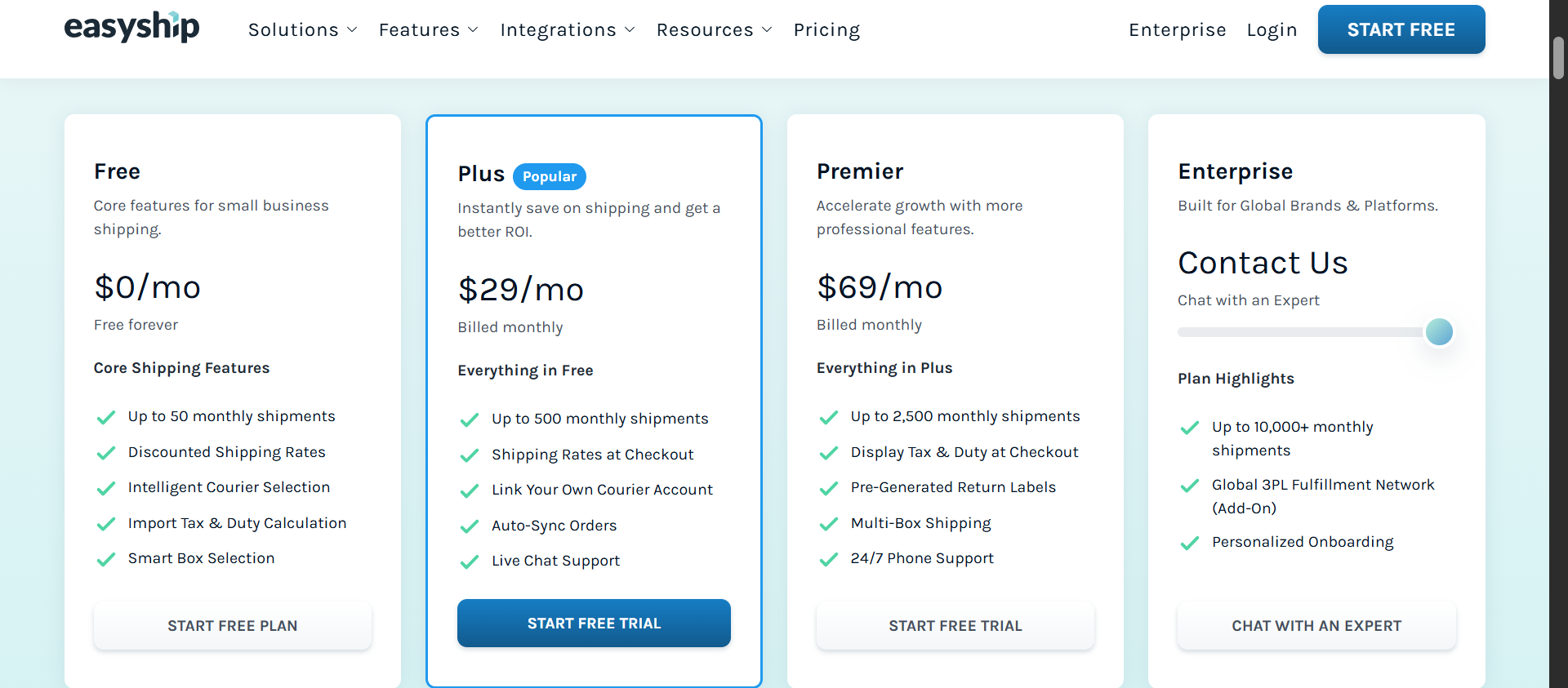
Easyship uses a freemium model with a genuinely capable free tier.
- Free plan covers up to 50 shipments per month with one store integration and access to pre-negotiated courier rates across 250 plus carriers
- Plus plan is $29 per month for up to 500 shipments with branded tracking and automation
- Premier plan is $69 per month for up to 2,500 shipments
- Enterprise pricing is available on request
No per-label fees on any plan. No hidden surcharges outside of courier costs. Even on the free plan, you get access to Easyship's pre-negotiated international courier rates.
ShippingEasy Pricing
ShippingEasy also has a free tier, but it is tighter.
- Starter plan is free for up to 25 shipments per month with up to 3 store integrations
- Growth plan is $19.99 per month for up to 200 shipments and includes phone, email, and chat support
- Basic plan covers up to 500 shipments at $29.99 per month
- Plus plan is $49.99 per month for up to 1,500 shipments
- Select plan is $69.99 per month for up to 3,000 shipments
- Premium plan is $99 per month for up to 6,000 shipments
- Enterprise covers 10,000 plus shipments at custom pricing
One thing to watch: connecting your own carrier account on ShippingEasy carries an additional monthly fee depending on your plan tier. That adds up if you have multiple carrier accounts.
Pricing verdict: ShippingEasy's paid plans start slightly cheaper, but Easyship's free tier gives you more courier access out of the box. For international sellers, Easyship delivers more value per dollar.
Carrier Support: 250 Plus Couriers vs 4
This is where the Easyship vs ShippingEasy gap gets significant.
Easyship Carrier Access
- 250 plus global couriers including DHL, UPS, Aramex, SF Express, Australia Post, DHL Express, and dozens of regional carriers
- Pre-negotiated rates, no carrier account setup needed
- Real-time rate comparison at checkout across all couriers
- Covers 220 plus countries and territories
ShippingEasy Carrier Access
- USPS, UPS, FedEx, and DHL only
- Discounted rates on USPS and UPS, but FedEx rates are not discounted
- International shipping available through the GlobalPost program using USPS International services
- Can connect your own carrier accounts, though this carries an additional monthly fee
- Limited to domestic and basic international coverage
ShippingEasy does offer some international coverage through the GlobalPost program, but it routes shipments through USPS infrastructure. It is not the same as having access to 250 plus global couriers with real-time rate comparison and full duty calculation.
Carrier verdict: Easyship wins clearly on carrier variety and global reach. ShippingEasy is solid for domestic US carriers but limited beyond that.
International Shipping Software: Easyship Is Built for It, ShippingEasy Is Not
This is the most important section in the entire Easyship vs ShippingEasy comparison for any seller shipping outside the US.
Easyship as International Shipping Software
- Automated duty and tax calculations displayed at checkout before the customer pays
- Full landed cost transparency so customers know exactly what they owe including import fees
- Auto-generated customs documentation for every international shipment
- Covers 220 plus countries and territories
- Supports both Delivered Duty Paid and Delivered Duty Unpaid options
- Reduces failed deliveries caused by surprise customs charges on arrival
This is what makes Easyship genuinely different as international shipping software. When a customer in Germany or Canada sees the full cost including import duties at checkout, they complete the purchase with confidence. No surprises at delivery. No refused packages. No chargebacks.
ShippingEasy International Shipping Limitations
- International shipping is available through the GlobalPost program via USPS
- No automated duty and tax calculation at checkout
- No upfront landed cost display for customers
- Customs documentation is handled through the GlobalPost infrastructure, not natively within ShippingEasy
- Tracking can become unreliable once packages leave the US postal network
- One verified user review specifically noted that international orders sometimes pose difficulties with addresses being rejected by the US postal system
Third-party analysis also confirms that ShippingEasy's international shipping features are restricted compared to more specialized platforms. Customs documentation, duties calculation, and cross-border workflows are limited when measured against what dedicated international shipping software like Easyship offers.
International verdict: For cross-border selling at any real volume, Easyship is the better international shipping software by a wide margin. ShippingEasy works for occasional international orders but is not built for regular global operations.
Automation: Both Are Solid, for Different Workflows
Easyship Automation
- Shipping rules based on delivery zone, courier, weight, and destination
- Auto-selects cheapest or fastest courier based on your preferences
- Auto-generates customs documentation for international shipments
- Default shipping preferences applied automatically at checkout
- Branded returns portal with automated approval workflows
Clean, reliable automation designed around ecommerce order flows.
ShippingEasy Automation
- Strong automation rules for domestic shipping workflows
- Auto-assigns postage based on order type, weight, and dimensions
- Batch label printing for high-volume operations
- Automated order imports from Shopify, Amazon, eBay, Etsy, and more
- Automatic tracking updates sent to customers post-shipment
- Built-in email marketing automation for customer retention
ShippingEasy actually has a strong automation engine for domestic sellers. The built-in email marketing tool is a genuine differentiator, letting you automate post-purchase communication and review requests without a separate platform.
Automation verdict: For domestic multi-channel operations, ShippingEasy's automation is genuinely strong. For international shipping automation, Easyship covers territory ShippingEasy simply cannot.
Integrations: Easyship Covers More Ground
Easyship Integrations (100 plus)
- Shopify, WooCommerce, BigCommerce, Magento
- Amazon, eBay, Etsy, Kickstarter
- Tracking, analytics, and returns tools
- API access for custom integrations
ShippingEasy Integrations (30 plus)
- Shopify, Amazon, eBay, Etsy, Walmart, BigCommerce, WooCommerce, Magento
- QuickBooks for accounting
- Rithum and other marketplace tools
- Basic API access, primarily GUI-focused
ShippingEasy covers the most important ecommerce platforms well. Where it falls short is in deeper integrations for growing tech stacks. The API is functional but limited compared to what more developer-focused platforms offer.
Easyship has a larger integration catalog and broader API access, making it easier to connect to custom tools as your operation scales.
Integration verdict: Easyship covers more platforms and offers stronger API flexibility. ShippingEasy covers the core platforms most small sellers need.
Returns Management: Easyship Is More Polished
Easyship Returns
- Branded, customizable returns portal customers access directly
- Store owners approve or reject returns before labels are generated
- Return labels pull from Easyship's carrier network
- Clean post-purchase experience that matches your store branding
ShippingEasy Returns
- Basic return label support
- No native automated returns portal
- Third-party analysis confirms this is a gap, describing it as a major limitation for brands dealing with consistent return volumes
- Returns process requires more manual handling than Easyship
Returns verdict: Easyship wins on returns experience, especially for stores where post-purchase experience is a priority.
Inventory Management: ShippingEasy Has the Edge
This is one area where ShippingEasy genuinely outperforms Easyship.
ShippingEasy includes inventory management tools that sync stock levels across multiple platforms in real time. Multiple users highlight this as a standout feature, particularly for sellers managing products across Shopify, Amazon, and eBay simultaneously.
Easyship's inventory management is basic by comparison. If inventory control is a core part of your daily operation, ShippingEasy has a real advantage here.
Inventory verdict: ShippingEasy wins on inventory management for multi-channel sellers.
Ease of Use: Both Are Accessible, ShippingEasy Has a Learning Curve at Scale
Easyship
- Setup takes under 10 minutes
- Clean, intuitive dashboard built for ecommerce store owners
- Connect your store and start comparing courier rates within an hour
- No technical knowledge required
- Gets more powerful as your store grows internationally
ShippingEasy
- Easy to get started for basic shipping tasks
- Dashboard can feel cluttered as features accumulate
- Some users report the interface becomes less intuitive when managing complex multi-store setups
- Built-in marketing tools add depth but also add complexity
- Strong onboarding support available on paid plans
Both platforms are accessible. Easyship stays cleaner as it scales. ShippingEasy can feel more complex once you are using the full feature set including marketing, inventory, and multi-store management.
Ease of use verdict: Easyship is easier for sellers focused on shipping. ShippingEasy has more moving parts but strong onboarding support to help you through them.
Customer Support: ShippingEasy Has Phone Access on Paid Plans
Easyship Support
- Email and live chat available
- 24/7 support on higher-tier plans
- Onboarding specialists for paid accounts
- Generally responsive across time zones
ShippingEasy Support
- Phone, email, and chat support on paid plans
- Phone support is a standout feature that users frequently praise
- Live agent access during business hours
- Free tier is limited to knowledge base support only
- Some users have noted support is not available 7 days a week on lower tiers
ShippingEasy's phone support on paid plans is genuinely valued by its users. For sellers who want to talk to a real person when something goes wrong, that matters.
Support verdict: ShippingEasy edges ahead on support accessibility for paid users thanks to phone access. Easyship offers 24/7 coverage on higher plans which gives it an advantage for international operations across time zones.
Who Should Use Easyship?
Easyship is the right choice if:
- You ship internationally or are planning to expand globally
- You need automated duty and tax calculations to eliminate failed deliveries
- You want access to 250 plus global couriers without negotiating your own rates
- You need a branded, professional returns experience for your customers
- You want international shipping software that works without developer help
- You are building an ecommerce brand that needs a platform to grow with it
Start your free Easyship plan here
Who Should Use ShippingEasy?
ShippingEasy makes more sense if:
- You ship primarily within the US through USPS, UPS, or FedEx
- You want built-in email marketing tools to manage customer retention
- Inventory management across multiple sales channels is a daily priority
- You want phone support included with your shipping software
- Your operation is domestic-focused and growing steadily at moderate volumes
ShippingEasy is a solid tool for the seller it is built for. If you fit that profile, it delivers real value.
The Final Verdict on Easyship vs ShippingEasy
Here is the honest take on the ShippingEasy vs Easyship debate.
ShippingEasy is a reliable platform for domestic US sellers. The automation is solid, the inventory tools are strong, the email marketing feature is a genuine bonus, and the phone support gives it a personal touch that a lot of users appreciate.
But as soon as you start selling internationally at any real volume, ShippingEasy shows its limitations. Restricted customs documentation, no automated duty calculation at checkout, no global courier network, and a weak returns portal are real gaps for brands growing beyond US borders.
Easyship was built specifically to solve those problems. The 250 plus courier network, automatic landed cost calculations, full customs documentation, and branded returns experience make it the stronger platform for any ecommerce brand with global ambitions.
In the Easyship vs ShippingEasy comparison, if your store is growing internationally, the choice is clear.
Not sure which shipping software is right for your store? Explore the best shipping software for ecommerce here or check out more Easyship alternatives worth considering.
Frequently Asked Questions
Is Easyship better than ShippingEasy for international shipping?
Yes, significantly. Easyship is purpose-built as international shipping software. It automatically calculates duties and taxes at checkout, auto-generates customs documentation, and shows customers the full landed cost before they pay. ShippingEasy handles basic international shipping through the GlobalPost program but has no automated duty calculation and limited customs documentation capabilities for regular cross-border operations.
Does ShippingEasy have a free plan?
Yes. ShippingEasy's Starter plan is free for up to 25 shipments per month with up to 3 store integrations. However, the free tier only includes knowledge base support, no phone or live chat access. You need to upgrade to the Growth plan at $19.99 per month to unlock phone, email, and chat support.
Does Easyship have a free plan?
Yes. Easyship's free plan covers up to 50 shipments per month with access to pre-negotiated rates across 250 plus global couriers and no per-label fees. That is twice the shipment allowance of ShippingEasy's free tier with significantly more carrier access. Try it free here.
Which platform has better inventory management?
ShippingEasy. It includes built-in inventory management tools that sync stock across multiple sales channels in real time. Multiple user reviews highlight this as a standout feature. Easyship's inventory management is basic by comparison. If inventory control is a core daily need, ShippingEasy has the advantage.
Does ShippingEasy support international shipping?
ShippingEasy supports international shipping through the GlobalPost program using USPS International services. However, it does not offer automated duty and tax calculation at checkout, no upfront landed cost display for customers, and limited customs documentation compared to dedicated international shipping software like Easyship. For regular cross-border selling, this is a meaningful limitation.
Which platform integrates better with Shopify?
Both integrate natively with Shopify. Easyship connects quickly and gives you full rate comparison, duties calculation, and branded tracking at checkout. ShippingEasy also integrates well with Shopify and adds inventory syncing and email marketing on top of shipping management.
Which platform is cheaper?
ShippingEasy's paid plans start at $19.99 per month compared to Easyship's $29 per month. However, Easyship's free plan allows up to 50 shipments compared to ShippingEasy's 25. For international sellers, Easyship delivers significantly more value per dollar through its global courier network and automated customs tools.
Does ShippingEasy have a returns portal?
ShippingEasy does not have a native automated returns portal. Returns require more manual handling and third-party tools for a polished customer-facing experience. Easyship includes a branded, customizable returns portal that customers can access directly, with store owner approval workflows built in.
The Easyship vs ShippingEasy decision comes down to where your business is and where it is going. For US-focused domestic operations with inventory management needs, ShippingEasy is a solid choice. For international ecommerce brands that need real global reach and automated customs tools, Easyship is the stronger platform.
Read the full Easyship review here or explore the best shipping software for ecommerce.





Comments
Leave a Comment
Your email address will not be published. Required fields are marked *