AppSumo Alternatives: The Honest Breakdown You Actually Need
If you've been hunting for AppSumo alternatives, you've probably already noticed that most "comparison" articles are just thin lists with no real perspective. This one is different. I'm breaking down every real option, what they're actually good for, and who should use them.
Let me be real with you.
You're looking for an alternative to AppSumo because one of a few things happened:
- You got burned on a deal and want to know if there's a safer option
- You're a vendor who wants to list your product and you're comparing platforms
- You're just doing research to make sure you're buying from the best place possible
All three are valid. I've been in each of those seats.
I've spent years buying lifetime deals, testing SaaS tools, and watching platforms rise and fall. So I'm going to give you the honest breakdown that most comparison articles are too scared to give.
What AppSumo Is and Why People Go Looking for Alternatives
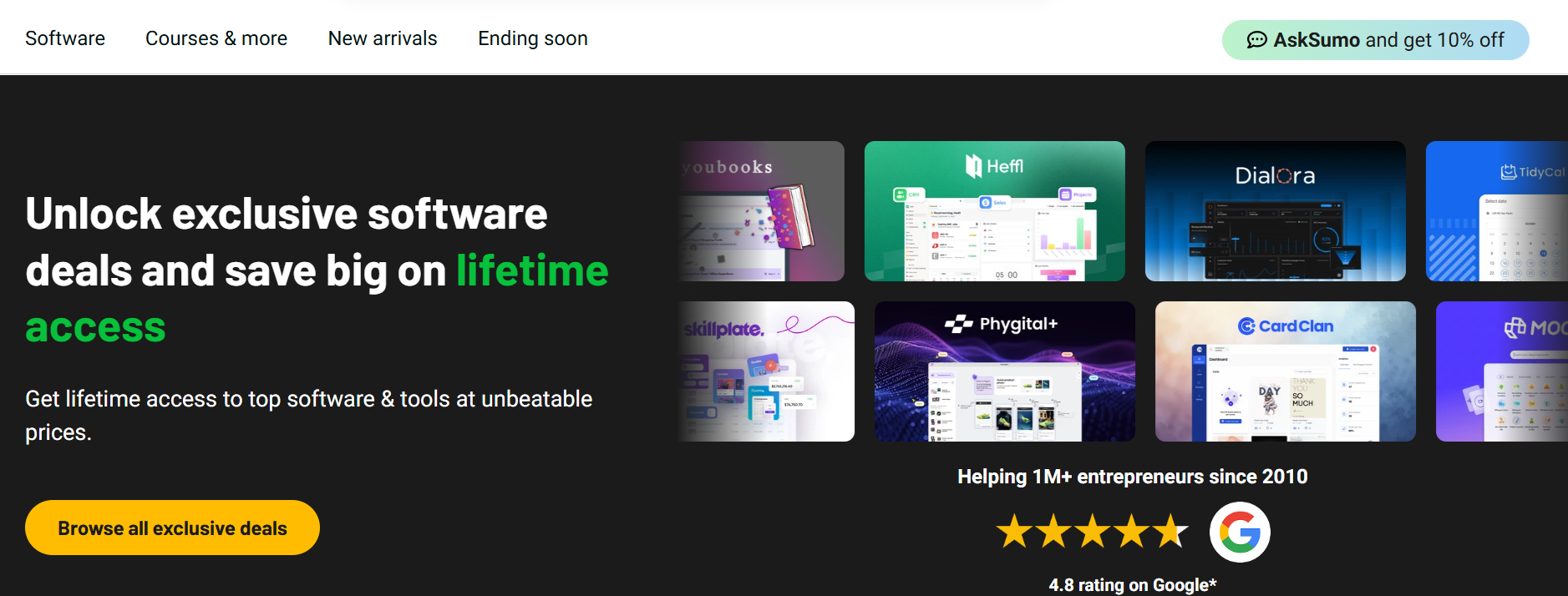
AppSumo is the biggest name in lifetime software deals. Period.
It was started by Noah Kagan back in 2010, originally out of his mom's basement, and it grew into the go-to marketplace for entrepreneurs, marketers, and small business owners who want to lock in software at a one-time price instead of paying monthly forever.
The idea is simple: a SaaS company wants to grow fast, so they offer their product at a steep discount in exchange for a big wave of early users. You pay once. You use it forever.
That sounds amazing. And usually, it is.
But people start looking for alternatives to AppSumo for a few reasons:
- They want more purchase protection beyond the standard refund window
- They're a vendor and want to explore different revenue share terms
- They want startup credits instead of lifetime licenses
- They want self-hosted software they actually own
- They're just doing due diligence before buying
Each of those is a legitimate reason. And there are legitimate options for each one.
But here's the thing: most of those alternatives don't come close to what AppSumo does, especially when it comes to deal volume, product vetting, audience size, and buyer protection.
I'll explain exactly why at the end. But first, let's look at the real options.
Quick Comparison: AppSumo vs the Alternatives
Quick Comparison: AppSumo vs the Alternatives
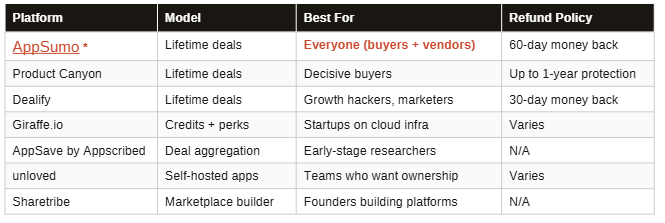
Before we dig in, here's the 30-second version:
| Platform | Model | Best For | Refund Policy |
|---|---|---|---|
| AppSumo | Lifetime deals | Everyone (buyers + vendors) | 60-day money back |
| Product Canyon | Lifetime deals | Decisive buyers | Up to 1-year protection |
| Dealify | Lifetime deals | Growth hackers, marketers | 30-day money back |
| Giraffe.io | Credits + perks | Startups on cloud infra | Varies |
| AppSave by Appscribed | Deal aggregation | Early-stage researchers | N/A |
| unloved | Self-hosted apps | Teams who want ownership | Varies |
| Sharetribe | Marketplace builder | Founders building platforms | N/A |
Now let's actually talk through each one. If you want to go deeper on any specific platform, check out our full AppSumo reviews breakdown.
The Real AppSumo Alternatives, Broken Down
1. Product Canyon
TYPE: Lifetime Deal Marketplace
Product Canyon is the closest thing to AppSumo in terms of format. It's a deal marketplace where you can buy lifetime licenses to SaaS tools at discounted prices.
The big differentiator they lean into is purchase protection that extends up to a year after buying. That's longer than most platforms.
The catch? The full-refund window is short. They want you to commit fast, and in exchange they give you longer-term coverage after the purchase.
This works if you're already sold on a product and just want a backup net. It doesn't work if you need time to actually test things out before committing.
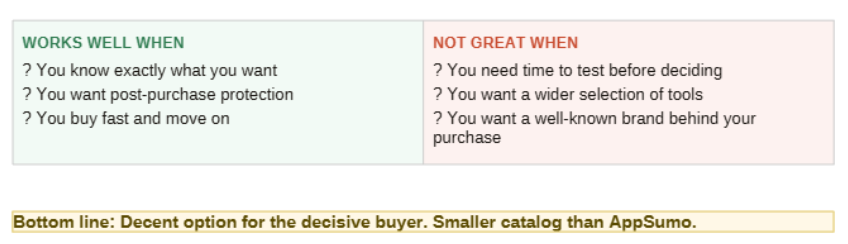
Works well when:
- You know exactly what you want
- You want post-purchase protection
- You buy fast and move on
Not great when:
- You need time to test before deciding
- You want a wider selection of tools
- You want a well-known brand behind your purchase
Bottom line: Decent option for the decisive buyer. Smaller catalog than AppSumo.
2. Dealify
TYPE: Lifetime Deal Marketplace
Dealify is a deal platform focused on marketers, growth hackers, and founders. They're younger than AppSumo and smaller in terms of audience and deal volume.
Where they try to compete is on flexibility for vendors. If you're a SaaS founder running a deal, Dealify claims to offer more flexible terms and better insight into campaign performance.
For buyers, you get a 30-day money-back guarantee and access to a curated set of marketing and growth tools. The catalog is smaller, but they claim it's more focused.
Works well when:
- You're a vendor exploring alternatives
- You want a marketing-focused deal platform
- You care about transparency from the platform
Not great when:
- You want broad tool selection
- You want the reach of a large buyer community
- You need longer refund windows
Bottom line: Solid for vendors. Narrower choice for buyers.
3. Giraffe.io
TYPE: Startup Credits and Perks
Giraffe.io is genuinely different from the others. It's not a lifetime deal marketplace. It's a startup perks platform.
Instead of paying once for access to a new SaaS tool, Giraffe.io gives you credits and discounts on tools you're already using, like AWS, GCP, GitLab, HubSpot, Asana, and Zendesk.
If your biggest costs are cloud infrastructure and established SaaS platforms, this makes a lot of sense. You're reducing burn, not adding new tools.
But if you're looking for sites like AppSumo that offer straight-up lifetime deals on new software, Giraffe.io isn't what you need.
Works well when:
- You're a startup burning on AWS or GCP
- You want credits, not new tool licenses
- You're already locked into major SaaS vendors
Not great when:
- You want lifetime deals on new SaaS tools
- You're not using mainstream enterprise software
- You're at pre-product stage
Bottom line: Different model entirely. Not really an AppSumo competitor.
4. AppSave by Appscribed
TYPE: Deal Aggregator
AppSave is more of a deal discovery tool than a marketplace. It aggregates deals from across the web so you can compare discounts before you buy.
It's free to use, which is nice. But it doesn't sell anything directly. Think of it as a price comparison engine for SaaS lifetime deals.
If you're early in your research phase and want to see what's available without committing to any one platform, AppSave is useful. But if you're ready to buy, you still end up going to the actual marketplace.
Works well when:
- You're in research mode
- You want to compare deals across platforms
- You're not ready to buy yet
Not great when:
- You actually want to purchase something
- You need buyer protection
- You want a curated, vetted deal experience
Bottom line: A research tool, not a buying platform.
5. unloved
TYPE: Self-Hosted Apps
unloved is the most interesting outlier on this list. It sells self-hostable, Docker-ready apps that you deploy on your own infrastructure.
The pitch is ownership. You're not renting access from a SaaS vendor. You buy the code, you deploy it, and it's yours. No subscription, no vendor lock-in, no risk of the company shutting down and taking your access with it.
That's genuinely compelling for teams who have the technical chops to manage their own deployments. But it's a heavy operational lift, and it's a totally different buying experience from browsing AppSumo.
Works well when:
- You want to own, not rent, your software
- You have DevOps capacity
- You're building internal tools for your team
Not great when:
- You don't want to manage hosting
- You want plug-and-play SaaS tools
- You're non-technical
Bottom line: Niche but powerful for the right team. Not a direct alternative for most buyers.
6. Sharetribe
TYPE: Marketplace Builder
Sharetribe is on this list because it shows up in comparison results, but I'll be direct: it's not really an AppSumo alternative in any meaningful sense.
Sharetribe is a platform for building your own two-sided marketplace. If you want to launch something like Airbnb or Etsy for a niche, Sharetribe is a solid no-code way to do it.
That's a completely different use case from buying discounted SaaS tools. The only overlap is that both involve the word "marketplace" in some sense.
Bottom line: Not an AppSumo alternative. Completely different product.
"Most AppSumo alternatives are alternatives in name only. Nothing runs the same playbook at the same scale."
The Verdict: Which One Actually Wins?
Here's where I give you the straight answer.
If you're a buyer looking for lifetime SaaS deals, none of the alternatives beat AppSumo on the things that actually matter:
- Deal volume. AppSumo has thousands of active and past deals. No one else is close.
- Product vetting. They turn away the majority of products that apply. What gets listed has been reviewed.
- Buyer protection. A 60-day money-back guarantee on lifetime deals is genuinely strong. You have two full months to test something before you're locked in.
- Community and reviews. AppSumo has a massive buyer community that leaves detailed, honest reviews. That social proof is invaluable when you're deciding whether to pull the trigger on a new tool.
- AppSumo Plus. For heavy buyers, the Plus membership stacks on extra discounts that pay for themselves fast. Check out the best AppSumo deals we've tracked to see exactly how much you can save.
The alternatives have real use cases. Product Canyon if you want post-purchase protection. Giraffe.io if you're a startup cutting cloud costs. unloved if you want code ownership. Dealify if you're a vendor exploring your options.
But if you're a founder, marketer, or entrepreneur who wants to find and buy great software at a fraction of the regular price, there's one place that's been doing this better than anyone else for over a decade.
That's AppSumo.
When You Actually Should Use an Alternative
I want to be fair here, so let me give you the honest scenarios where a different platform actually makes more sense.
Use Product Canyon if: You're a quick decision-maker and you care more about what happens after you buy than having time to test. Their longer purchase protection window is a real differentiator for committed buyers.
Use Giraffe.io if: You're an early-stage startup with existing commitments to AWS, GCP, or other major cloud or SaaS platforms. Getting credits on what you already pay for is more valuable than buying new tools at a discount.
Use unloved if: You have a technical team, you're sick of SaaS subscription risk, and you want to own the software you rely on. This is a legitimate philosophical stance and unloved makes it practical.
Use AppSave if: You're still in research mode and you want to see the full landscape of deals available across multiple platforms before you commit to buying anywhere.
Use Dealify if: You're a SaaS vendor and you want to run a deal with more flexible terms and more hands-on support from the platform. For buyers, the selection is narrower, but for product owners it's worth exploring alongside AppSumo competitors before making a final call.
FAQs About AppSumo Alternatives
Is AppSumo still worth using in 2026?
Yes, genuinely. The platform has been running for over a decade, has a huge active buyer community, and continues to bring on solid products. The 60-day refund window means you have real time to test before you're committed. For anyone buying SaaS tools on a budget, it's still the first place to check.
What's the main difference between AppSumo and Dealify?
Scale and reach, mostly. AppSumo has a much larger audience, more deals, and a longer track record. Dealify is smaller and more focused on marketers and growth hackers. For vendors, Dealify offers more flexible commission structures. For buyers, AppSumo wins on selection and community reviews.
Are lifetime deals on these platforms actually safe to buy?
That depends on the platform and the product. On AppSumo specifically, the vetting process is strict, and the refund window gives you real protection. Some lifetime deal products have shut down over the years, that's a real risk with any early-stage SaaS, but established platforms like AppSumo do more than most to protect buyers.
What is AppSumo Plus and is it worth it?
AppSumo Plus is a paid membership tier that gives you an extra 10% off all deals plus early access to new launches. If you're buying more than a few deals a year, the membership pays for itself. It's designed for frequent buyers who want to maximize savings on lifetime deals.
Can vendors list their product on multiple platforms at once?
It depends on the exclusivity terms of your deal. AppSumo deals are typically run as exclusive promotions during the campaign period. After the deal ends, you have more flexibility. It's worth reading the vendor agreement on each platform carefully before signing. You can also read more about how the platform operates in our AppSumo careers and company overview.
What's the best AppSumo alternative for startups specifically?
If you're a startup buying tools, AppSumo is still your best bet for lifetime deals. If you're a startup trying to reduce cloud and infrastructure costs, Giraffe.io is worth looking at for credits on platforms like AWS or GCP. These solve different problems, so it's less about choosing one and more about knowing which problem you're solving.
Does AppSumo have a refund policy?
Yes. AppSumo offers a 60-day money-back guarantee on all purchases. That's one of the strongest buyer protections in the lifetime deal space. You have two full months to test a product and request a refund if it's not working for you.
At the end of the day, the market for lifetime software deals exists because entrepreneurs and small teams need great tools without enterprise-level budgets. That's a real need and it's not going away.
The AppSumo alternatives on this list all serve real niches. But when it comes to finding and buying discounted SaaS tools with solid buyer protection, a huge product catalog, and a community that actually helps you decide, AppSumo is still the one to beat in 2026.
This article contains affiliate links. If you purchase through them, I may earn a commission at no extra cost to you.








Comments
Leave a Comment
Your email address will not be published. Required fields are marked *