Business Tax Advisor: 6 Proven Steps to Choose the Best
A business tax advisor can help you stop guessing about taxes and start planning for them.
Here's what I hear from business owners all the time.
“Am I paying more tax than I should?”
“Why does my tax bill surprise me every year?”
“My accountant files my return, but does anyone actually plan my taxes?”
“Do I even need an advisor, or is that just another bill?”
If any of those sound familiar, you're in the right place.
I'm going to walk you through what an advisor does, who needs one, and how to pick the right one.
No jargon.
No hype.
No promises of magic savings.
Just a clear way to figure out if you need help and who to trust with it.
The short version:
• A business tax advisor helps you plan taxes before you make decisions.
• A tax preparer files what already happened.
• A bookkeeper keeps your numbers clean.
• The best advisors explain things in plain English.
• Nobody can honestly guarantee a savings number.
Want proactive tax support while you read? Explore HeyDrew's service to see what a forward-looking plan could look like for your business.
What Does a Business Tax Advisor Actually Do?
A business tax advisor looks at your whole money picture and helps you make smarter tax decisions.
That means they look at how you earn money, how you pay yourself, and what you spend.
They also look at what's coming next.
Think hiring, buying equipment, opening a new location, or selling the company.
Then they explain how each move could affect your taxes.
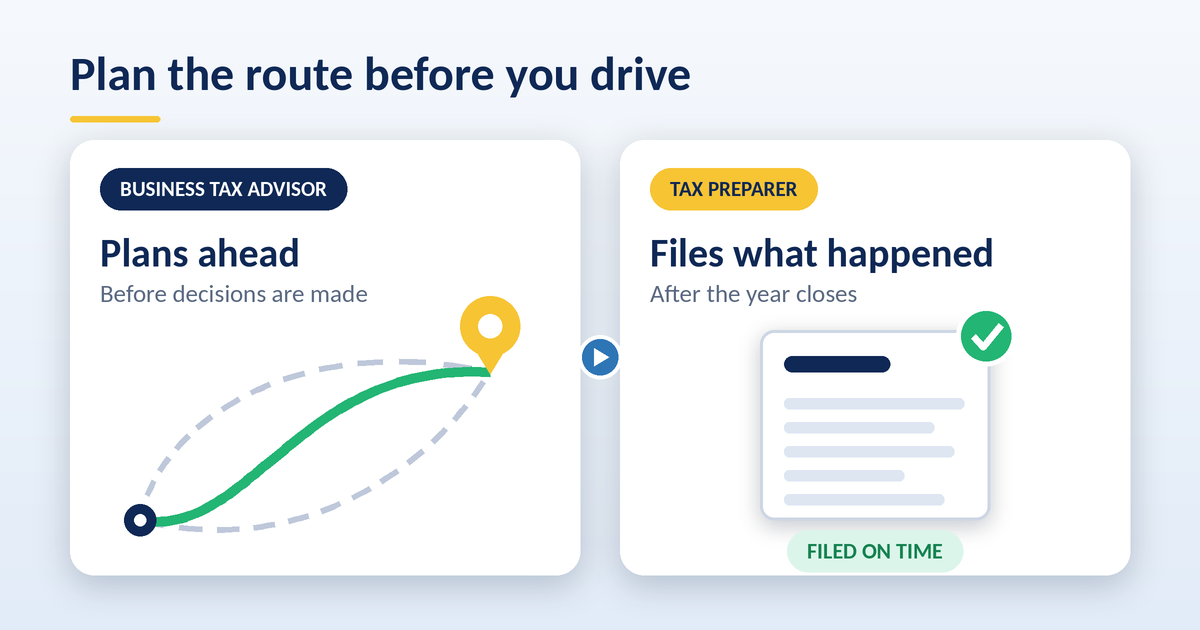
Think of it like a GPS.
A tax preparer tells you where you ended up.
An advisor helps you pick the route before you drive.
Here's what that usually looks like:
• Planning ahead: They map out your tax picture before the year ends.
• Explaining your options: They show you the tradeoffs in plain language.
• Checking your structure: They look at whether your entity type still fits.
• Flagging risk: They point out things that could cause problems later.
• Working with your team: They coordinate with your CPA, bookkeeper, and attorney.
That's the core of good business tax advice.
It's less about tricks and more about timing, structure, and paying attention.
Business Tax Advisor vs. Bookkeeper vs. Tax Preparer vs. CPA

This is where most people get tangled up.
Four jobs.
Four different purposes.
Sometimes one person does more than one.
Here's the simple breakdown:
• Bookkeeper: Records your income and expenses and keeps your books current.
• Tax preparer: Files your return based on what already happened.
• CPA: A licensed accountant who may handle accounting, audits, filing, and sometimes planning.
• Business tax advisor: Focuses on planning, so you know the tax impact before you act.
The big difference is timing.
Bookkeeping and return preparation look backward.
Planning looks forward.
Compliance keeps you safe.
Planning helps you make better choices.
You need both.
Let me give you an example.
Say you run a small design agency.
Your bookkeeper tracks every invoice.
Your preparer files your return in March.
Everything is accurate and on time.
But nobody ever asked whether to buy new equipment in December or January.
Nobody asked whether your entity type still makes sense at your income level.
That's the gap an advisor fills.
Does that mean your CPA can't plan?
Nope.
Plenty of CPAs do great planning.
The real question is whether the person you hired is actually doing it.
If you want the full side-by-side, I broke it down in this guide to tax strategist vs CPA.
Business Tax Advisor Services: What You Can Expect
Not every advisor offers the same thing.
That's why you need to know what's actually included.
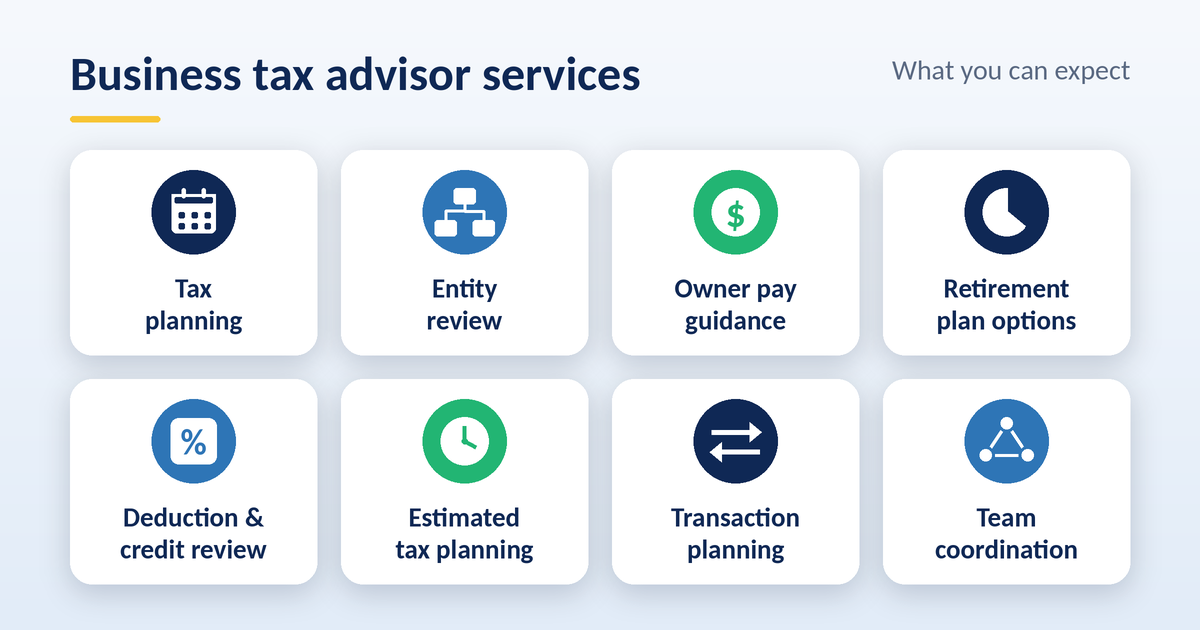
Here are the most common business tax advisor services:
• Tax planning: A year-round plan to manage your tax picture.
• Entity review: A check on whether a sole proprietorship, LLC, partnership, or S corporation fits.
• Owner pay guidance: A look at salary, distributions, and payroll taxes.
• Retirement plan options: A comparison of plans like a SEP IRA, SIMPLE IRA, or solo 401(k).
• Deduction and credit review: A check that you're not missing things you qualify for.
• Estimated tax planning: Help avoiding underpayment surprises.
• Transaction planning: Support when you buy, sell, or restructure a business.
• Coordination: Working with the rest of your financial team.
Some advisors also prepare returns.
Others only plan.
Both models can work.
You just need to know which one you're buying.
For a deeper look at what proactive planning includes, check out these tax planning services.
Good Business Tax Advice in Real Life
Let's make this real.
Here are a few examples of questions a tax advisor for business owners can help with.
Example 1: The growing freelancer
Say you're a consultant and your income doubled this year.
You're still filing as a sole proprietor.
You might ask:
• Should I look at an S corporation election?
• How should I pay myself?
• Would a retirement plan lower my taxable income?
An advisor can run the numbers and walk you through the tradeoffs.
Example 2: The equipment buyer
Say you run a landscaping company.
It's November and you're eyeing a new truck.
You might ask:
• Does buying now or next year make more sense?
• How does financing change things?
• Is this purchase actually good for my cash flow?
Taxes shouldn't be the only reason you buy something.
A good advisor helps you weigh both.
Example 3: The owner planning an exit
Say you want to sell your company in a few years.
You might ask:
• How should I prepare before the sale?
• What happens to my tax picture after closing?
• What should I clean up now?
Planning early often gives you more options than planning at the last minute.
Notice something.
None of these answers is a guaranteed savings number.
They depend on your numbers, your goals, and the rules.
That's the honest version of business tax advice.
Thinking about getting proactive with your taxes? Take a look at HeyDrew's service as a next step.
Do You Need a Tax Advisor for Business?
Not everyone does.
If your business is brand new and very simple, a good preparer and bookkeeper may be enough for now.
But you might be ready for an advisor if:
• Your income jumped or became harder to predict.
• You're hiring employees for the first time.
• You're thinking about changing your entity type.
• You're planning big purchases.
• You own rental property or have multiple income streams.
• You get surprise tax bills even though you did everything right.
• You're planning to sell or step back from the business.
• You want someone to talk to in October, not April.
If you run a smaller company, this guide to a small business tax advisor can help you figure out the right level of support.
Benefits of Working With a Business Tax Planning Advisor
Let's talk about what you actually get.
• Fewer surprises: You see your tax picture earlier.
• Better timing: You make big moves with the tax impact in mind.
• Clearer decisions: You understand the tradeoffs.
• Less stress: You're not scrambling in March.
• Stronger records: You know what to track and why.
• A second set of eyes: Someone checks your structure and assumptions.
Here's the honest part.
An advisor can't promise you a specific dollar amount in savings.
Anyone who does is selling you something.
What a good business tax planning advisor can do is help you make informed decisions.
That's the real value.
How to Choose a Business Tax Advisor
Picking someone feels like a big deal.
It is.
But you can keep it simple.
Here's a step-by-step way to do it.
Step 1: Start with your situation.
Write down what's going on.
• Your entity type
• Your income range
• Your number of employees
• Your big plans for the next 12 months
That makes every conversation more useful.
Step 2: Check credentials.
Look for a CPA, EA, tax attorney, or other relevant credential.
Credentials don't guarantee skill.
But they show training and accountability.
Step 3: Look for industry experience.
Someone who works with restaurants may not be the best fit for a software company.
Ask who they usually work with.
Step 4: Ask what you actually get.
Find out if you get a written plan, regular meetings, check-ins, and help carrying it out.
Step 5: Pay attention to communication.
Do they explain things in plain English?
Do they answer questions without making you feel dumb?
If it feels confusing on the first call, it'll feel worse later.
Step 6: Compare fees to the scope.
Don't shop on price alone.
Compare what's included.
You may also see the term business tax consultant.
Are they the same thing?
Not always.
This breakdown of a business tax consultant can help you sort out the difference.
Questions to Ask Before You Hire
Bring these to your first call.
About experience:
• How long have you worked with businesses like mine?
• What types of clients do you serve most?
• What credentials do you hold?
• Have you handled situations like mine before?
About fees:
• How do you charge: hourly, flat fee, or monthly?
• What's included in that fee?
• What costs extra?
• Can I get the quote in writing?
About deliverables:
• Will I get a written tax plan?
• How often will we meet?
• Will you help me carry out the plan?
• Will you work with my CPA and bookkeeper?
• What do you need from me?
About promises:
• How do you estimate potential savings?
• What are the risks?
If someone promises a number before looking at your records, walk away.
How Much Does a Business Tax Advisor Cost?
It depends.
I'm not going to throw out a number, because it would just be a guess.
Fees vary based on how complex your business is and what's included.
Here are the common pricing models:
• Hourly: You pay for time, which works well for one-off questions.
• Flat fee: You pay one price for a defined project, like an entity review.
• Monthly or quarterly retainer: You get ongoing support and check-ins.
• Bundled with tax prep: You get planning and filing together.
Ask what's included.
Ask what's not.
Then compare the cost to the size of the decisions you're making.
Red Flags to Watch For
Not every advisor is great.
Watch out for these:
• Guaranteed savings: Nobody can promise that.
• Pressure to decide fast: Good advice can handle a few days of thought.
• Vague explanations: If they can't explain it, be careful.
• No talk of risk or documentation: Every strategy has both.
• A one-size-fits-all pitch: Your business isn't generic.
• No plan to work with your current team: Silos cause mistakes.
Good advisors slow you down.
They ask questions first.
Looking for a relevant next step? Explore HeyDrew's service to see how proactive tax support could fit your business.
FAQs About Hiring a Business Tax Advisor
What does a business tax advisor do?
They help you plan taxes ahead of time.
They look at your income, structure, owner pay, and upcoming decisions.
Then they explain how those choices may affect your taxes.
Is a business tax advisor the same as a CPA?
Not always.
Some advisors are CPAs, and some aren't.
A CPA is a licensed accountant.
An advisor focuses on planning.
Many professionals do both.
When should I hire a business tax advisor?
Before big decisions.
Think hiring, buying equipment, changing your structure, or selling.
Earlier is almost always better than April.
Can a business tax advisor lower my taxes?
They can help you find legal ways to manage your taxes.
But no one can promise a specific result.
Your savings depend on your situation and the rules.
What's the difference between a tax advisor and a tax preparer?
A preparer files your return based on what already happened.
An advisor helps you plan before decisions are made.
Check credentials.
Ask about experience.
Get fees in writing.
Avoid anyone who guarantees savings.
This article is for general information only and isn't tax, legal, or financial advice.
Final Thoughts
Taxes don't have to feel like a yearly surprise.
Plan early.
Ask good questions.
Pick someone who explains things clearly.
And be careful with big promises.
That's how you find an advisor worth keeping.
If you're ready to find the right business tax advisor, explore HeyDrew's service as a next step toward proactive tax support.









Comments
Leave a Comment
Your email address will not be published. Required fields are marked *